
Our immediate response to the question posed by the title is YES!!!!
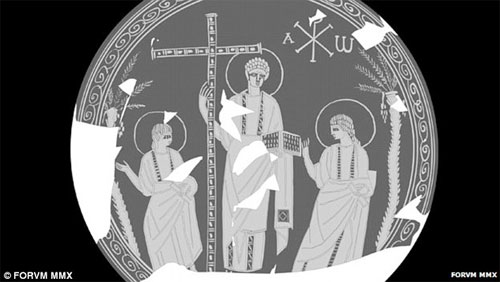
However, a piece of a glass plate from the 4th century does a very unique thing — it portrays Jesus without a beard. The discovery is considered one of the earliest representations of Jesus. It was found by archaeologists in Andalusia, Spain. They were part of the FORVM MMX project digging at the site of a religious building in the ancient village of Castulo dated to around 350 AD.
The glass plate probably held bread for the Eucharist.
The image engraved on the glass was also different in other respects. The artist portray Jesus as having short curly hair and wearing a toga. Pictured beside Jesus are the apostles Peter and Paul, who are also beardless. All three have halos over their head.
We have no idea if this rendering was based on even older images of Jesus, but obviously the people of this era accepted a beardless Jesus as realistic.
Shroud of Turin
What we do know is that it differs substantially from modern paintings of Jesus that depict Him with long flowing hair and a beard. Many of these are influenced by the shroud of Turin — that has an image of a man burned into what was probably a burial cloth. It shows a man with long hair and a beard. It is argued by some this was Jesus’ burial cloth and His image was burned into the cloth at the resurrection.
Though the Catholic Church has no official position on the Shroud, many modern images of Jesus, particularly of the Catholic variety, portray Jesus with long hair and a beard with a resemblance to the image on the Shroud.
However, it was reformer John Calvin (1509 -1564) who pointed out the biggest problem with the shroud. Citing John 20:6-7, Calvin says Jesus was wrapped in two pieces of cloth at His burial — one for His body and one for His head found rolled in a ball on the floor after Christ’s resurrection. So based on the scriptural record, the shroud is not Jesus’ burial cloth.
What does the Bible say?
But is the artists rendering of Jesus without a beard correct?
Most of us immediately ask: Didn’t Jesus have his beard plucked out by the Roman guards? In fact, the Gospel writers don’t mention that:
and they began to come up to Him and say, “Hail, King of the Jews!” and to give Him slaps in the face. (John 19:3 NASV note “in the face’ is not in the original text, but is added for clarification see also Mark 14:65 and Matthew 26:67-68)
Jesus was beaten several times during His imprisonment. However, there is no mention of soldiers pulling out Jesus’ beard, only that they hit Jesus in the face or beat upon His head as it reads in Matthew 27:30.
The only possible reference to Jesus’ beard being plucked comes from the Old Testament:
I gave My back to those who strike Me,
And My cheeks to those who pluck out the beard;
I did not cover My face from humiliation and spitting. (Isaiah 5o:6 NASV)
In this verse, Isaiah was describing the torture practices of the Assyrians who pulled out the beard of their captives including skin and flesh. The prophet said he was willing to go through this. In fact, Isaiah prophesied to Ahaz if he didn’t repent his beard would be pulled out (Isaiah 7:20). But some also believe the verse prophetically looked ahead to the torment Jesus went through because He was similarly scourged and spit upon (Matthew 27:27-31).
But does this Old Testament verse refer to Jesus? If the guards had pulled out Jesus’ beard, you would expect the Gospel writers to mention it and I suspect the guards would have done so, if Jesus had a beard.
Leviticus 19:27-28, says the Jewish men were not allowed to trim the edges of the beard or square it off. This was a reference to a religious rite practiced by many pagans in Canaan. It was an act of worship to their gods and the Israelis were not allowed to mimic that practice. But this did not require them to have a beard. But it was custom for men in the Old Testament to have one. King David had a beard (1 Samuel 21:13 NASV), as did Aaron (Psalm 133:2), Samson (Judges 16:17) and Ezekiel (Ezekiel 5:1). But Joseph didn’t (Genesis 41:14), as was the Egyptian custom.
As we move into the New Testament, there is not a single mention of a beard and it seems the custom of the day was to shave. It probably wasn’t a daily thing — stubble was in vogue. So perhaps the artist from the ancient village of Castulo had it right.
In one sense, whether Jesus had a beard is not significant to our faith but in another sense it is, as it shows that our perceptions of Jesus are sometimes influenced more by a picture on a wall, than the Biblical record. — EZ
Read:
- Was Jesus actually clean-shaven? Daily Mail





 OpentheWord.org
Leave a comment