
FOLLOW OUR PODCAST ON (search opentheword):
- Spotify
- Apple Podcasts
- IHeartRadio
- Listen Notes
- TuneIn
- Podchaser
- YouTube Music Podcasts (audio)
- Amazon podcasts
PODCAST NOTES:
ESPAÑOL: ¿Detuvo Dios la Construcción de un Tercer Templo Judío?
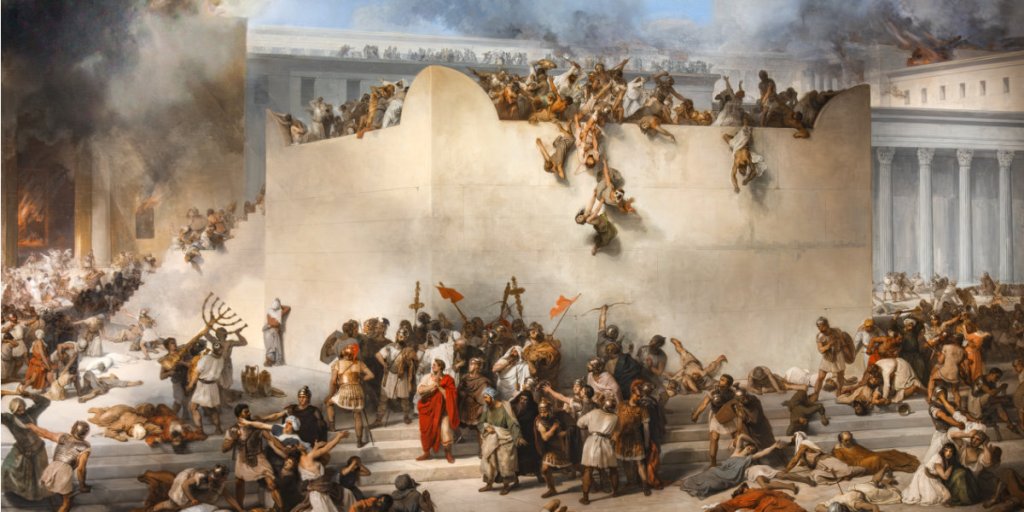
Since the Romans destroyed the Jewish Temple in 70 AD, the building of a third Jewish Temple has been a high priority for orthodox Jews.
Some Christians support it believing the temple is part of the End Times. They cite 2 Thessalonians 2, where Paul talks about the Antichrist proclaiming himself to be god and sitting in the temple and Revelation 11, where the apostle John is told to measure the temple.
Now some believe this is a physical temple, while others believe it is spiritual.
Over the centuries there have been several attempts to build a Temple in Jerusalem.
Perhaps the closest came in 361 AD, when Julian the apostate became the emperor of Rome.
Christianity was now the dominant religion in the Roman Empire.
However, Julian, who had been raised Christian, rejected his faith and sought to return Rome to its pagan roots. Thus the nickname Apostate.
This included restoring the pagan temples and even providing the financing to help construction.
As part of his agenda, Julian allowed the Jews to build a third Jewish temple.
Though Julian provided financial help, Hilkiycah, a prominent Rabbi, argued that gentile money should not be used in constructing the temple.
Whether Julian’s money was used or not, the Jews started building.
They had government support. They obviously had the finances and they had the workers.
But something strange happened.
Ammianus Marcellinus, a pagan historian and close friend of Emperor Julian, explained what took place in his book, The Roman History of Ammianus Marcellinus:
Julian thought to rebuild at an extravagant expense the proud Temple once at Jerusalem, and committed this task to Alypius of Antioch. Alypius set vigorously to work, and was seconded by the governor of the province; when fearful balls of fire, breaking out near the foundations, continued their attacks, till the workmen, after repeated scorchings, could approach no more: and he gave up the attempt.
He said balls of fire poured out of the ground, forcing the workers to stop construction. As a friend of Julian, Marcellinus would have been supportive of the emperor’s policies, so he wouldn’t be prone to embellishing a negative story.
In his book, Historia Ecclesiastica, Christian historian named Sozomen, who died in 450 AD, also stated that fires stopped the construction. He added that an earthquake which destroyed the work already completed was the final blow that ended the project.
We have no idea what caused those fires, but do know that a major earthquake hit the area in 363 AD.
Then to top it off, Julian the Apostate, the driving force behind the temple’s construction, was killed in battle that same year, limiting his reign to less than three years.
While secularists call it a coincidence, Christians called it providential. They believed God removed Julian because the Lord has done similar things in the past.
A Godly angel killed King Herod in Acts 12:23. God also struck down the Babylonian King, Nebuchadnezzar, with madness in Daniel 4:32-33.
The Christians also believed God was instrumental in stopping the construction of the Jewish Temple.
Why?
Because according to the Apostle Paul, the church and believers who are filled with the Holy Spirit are now God’s temple (1 Corinthians 3:16).





Leave a comment