
FOLLOW OUR PODCAST ON (search opentheword):
PODCAST NOTES:
Hi my name is Dean. In this podcast I want to talk about politics in the church. I can’t remember a time, when politics has become so dominant and divisive in our culture. It is everywhere and infecting everything
But before I do that, I need to provides some disclaimers.
First I am a conservative.
Secondly, during my career, I actually worked for a right leaning political party. While I was considering the job offer, my wife gave me some advice that ultimately proved to be true. She said, the job will require a bit of my soul, meaning you will end up defending the undependable, and I did.
Finally, after I left the political party, I worked with a non profit that was heavily involved in politics for nearly three decades. So politics has been a major focus of my working life.
So let’s talk about politics in the church.
A few months ago, my wife met with some Christian women. This took place a few weeks after the death of Charlie Kirk.
Charlie was a Christian, who was actively involved in politics. He was assassinated in September 2025, while addressing university students in Utah.
As the women enjoyed a time of fellowship, there had been no mention of politics.
But then one lady started talking about Charlie Kirk. She is a sincere, genuine believer actively involved in her church.
She described Kirk and those linked with him as racists and misogynists.
But other Christians hold the opposite view. Shortly after Charlie Kirk’s assassination in September 2025, CBN published an article entitled, “Charlie Kirk is a martyr: Christian Leaders react to stunning assassination”.
These represent two polarized opinions in the church about the same man.
I also know Christians who believe US President Donald Trump is the Antichrist. They compare the attempted assassination of Trump, where he was hit by a bullet in the ear to Revelation’s description of the Antichrist surviving a head wound in Revelation 13:3-4.
This opinion is so widespread, that articles have even appeared on Christian websites countering these claims, such as a Charisma News article entitled, “Donald Trump as the Antichrist: Separating Fact from Fiction”.
Then on the other side of the coin, there are articles comparing Trump to the Persian King Cyrus, who God called His shepherd in Isaiah 44:28.
Obviously, Trump can’t be both the antichrist and Jehovah’s Shepherd.
But people in the church hold these contradictory opinions.
Politics is divisive and increasingly its tentacles are infiltrating the church.
In a recent op-ed for the Christian Post, Mark Creech described a sad situation where politics ended a long standing Christian friendship:
“Recently, a man informed a friend of mine — by text message — that he could no longer maintain a friendship with him because of his “Republican values,” which he described as “ungodly.” He insisted he bore no hatred, yet declared the relationship effectively over. In just a few lines on a phone screen, a friendship ended. It was heartbreaking, but something increasingly common. It also reveals the real nature of our national divide.”
It’s disturbing that Christians are breaking fellowship because of politics. It tells us that sometimes, politics is more important than faith.
So how should Christians respond to politics in the Church?
As Jesus gathered His disciples, the Lord faced a similar problem.
Christ’s group of 12 disciple had men who were on the opposite extremes of the political spectrum of that day.
On one hand Jesus had Matthew who worked as a Roman tax collector. According to Mark 2:14, he was probably from the priestly tribe of Levi.
As a Jew working for Rome, Matthew would have been looked upon as a traitor because he had sold out to Rome. He would have been despised. Some Jews even considered it a sin to be found in the presence of Tax collectors as we read in Matthew 9:10-11.
Tax collectors were usually wealth, as they often skimmed money off the top. Whether Matthew did this we don’t know. But we do know that Matthew was rich, because he threw a lavish banquet to celebrate his decision to leave his job and follow Christ in Luke 5:29.
But in Mark 3:18, we read that within Jesus’ band of disciples, there was another man who was on the opposite side of the political spectrum, Simon the Zealot.
While Rome considered Zealots as terrorist, many Jews looked upon them as freedom fighters. The Zealots were a Jewish political movement dedicated to throwing off the Roman yoke, by force if necessary.
It was the Zealots who helped lead the rebellion that successfully drove the Romans out of Jerusalem in 66 AD. The Romans counter attacked in 70 AD sacking Jerusalem and destroying the Jewish Temple.
Within the Zealots, there were the Sicarii, a group of assassins. They carried daggers called sicae hidden in their cloaks, They would infiltrate large crowds to covertly knife Romans and their Jewish collaborators and and then quickly fade away in the crowd as part of their escape.
We have no way of knowing if Simon was a Sicarii, but as a Zealot, he would have sympathized with them. Matthew would have been a legitimate target for assassination.
Since Jesus only did what He saw the Father doing, God purposefully led Jesus to choose both of these men.
Now the disciples were not born with halos over their heads as medieval paintings often portrayed them. They were flesh and blood like the rest of us.
The Lord was undoubtedly fully aware of the political tensions brewing within His small band.
I have no doubt in the early days, there were a few heated political discussions, snide remarks and even some back stabbing, metaphorically.
I think we see hints of this political tension in Luke’s description of the 12 apostles in chapter 6 verses 13 and 14. We read that Simon was called “the Zealot.”
While, this nick name distinguished him from Simon Peter, it also tells us that the Zealot was vocal about his political beliefs.
The Zealot and the former Tax collector represented the two opposite political extremes.
I suspect the rest of the disciples probably fell somewhere in the middle.
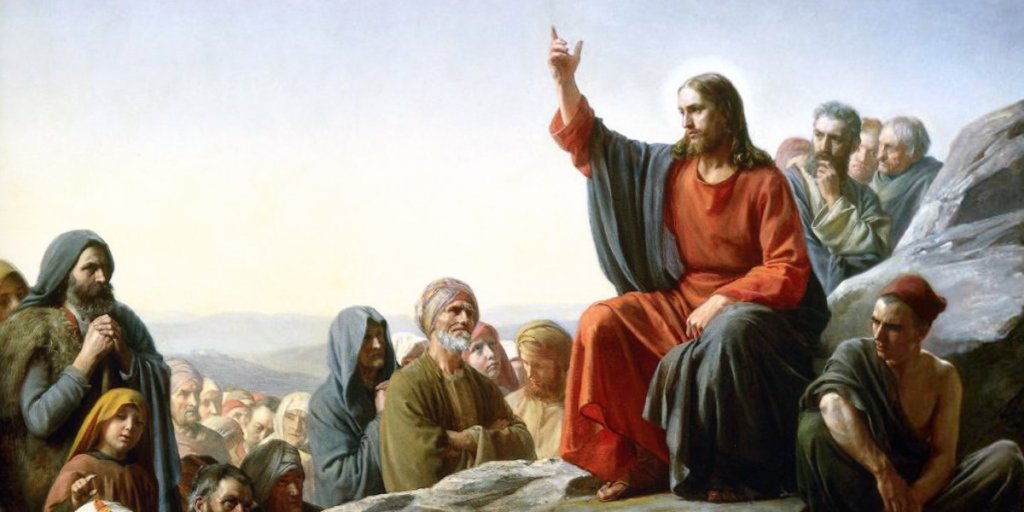
The political division was real and Jesus actually addressed this brewing tension in one of His earliest sermons known as the sermon on the mount.
Though Jesus spoke this sermon to a large crowd, Luke writes that just before the Lord started speaking he turned quote “His gaze on the disciples” Luke 6:20.
Though this sermon was delivered to the whole crowd, it was clearly directed at Christ’s 12 disciples and I suspect the political divisions surfacing within their group.
With this political tension as the back drop let’s take a second look at what Christ said.
First, Deal with Your Anger
First in Matthew 5:22-24, Jesus told them that anyone who is angry with his brother, insults or calls him a fool will answer for their words. He then added they needed to be reconciled with their brother.
Why would Jesus specifically refer to someone calling another fool. It feels oddly specific.
Was Simon the Zealot calling Matthew a fool for collaborating with the Romans?
Equally important, are you and I guilty of the same thing? Well, speaking for myself, I may need to go to confession, even though I am not Catholic.
Secondly, Don’t Retalliate
Secondly, in Matthew 5:38-39, Jesus told His disciples that they must not retaliate against their enemy. If they slap you on the one cheek, then offer them your other cheek, Jesus said.
I suspect many of the disciples were disgusted with Matthew. Simon in particular may have been thinking some not so nice thoughts about Matthew.
I have wondered at times, if Jesus was hoping that all His band of merry men would still be alive after six months. You may think that is outrageous, but wasn’t one of Christ’s disciples guilty of helping the High Priest and his cohorts crucify Christ.
Thirdly, You Must Love and Forgive Your Enemy
Thirdly in Matthew 5:43-48, Jesus told the disciples that they must love and forgive their enemies and to even pray for them.
But notice how Jesus gave a twist of the knife in verse 46, when he says that even tax collectors love those who love them.
Without mentioning any names, this was undoubtedly a not so subtle reference to Matthew and how the disciples including Simon must love their enemy even if they were former tax collectors.
Fourthly, Forgive Your Debtors
Fourthly, in Matthew 6:12, Jesus told them that they needed to forgive their debtors.
In Luke 19, we are told the story of Zaacheus another Jewish Tax collector who was described as being wealthy. After his conversion to Christ he promised to return four times the amount to anyone he cheated.
From Zaacheus’ testimony it was obvious he overcharged when collecting taxes, which was typical of tax collectors of that time. If Matthew had done the same, he needed to be forgiven.
Finally, Don’t Judge
Finally towards the end of His sermon in Matthew 7:1-3, Jesus delivered His coup d’etat. He told His disciples not to judge because when you judge, you are guilty of the same thing.
This is of course one of the common sins of the politically motivated believer. We find it so easy to judge those on the opposite side of the political spectrum.
By judging others for their political motivations reveals that we are politically motivated as well. We are guilty of the same thing.
While the Sermon on the Mount has practical advice for all believers, I suspect huge chunks of it were specifically centred on the political divisions among the Lord’s disciples.
This advice if very much applicable today as the political rhetoric heats up.
In order to heal the political divide, we must forgive. We must quit judging.
But equally importantly, we must set aside our political beliefs for the sake of the Kingdom of God.
Don’t bring your personal political beliefs to the church.
Jesus wants to draw all men to himself to himself, the Zealots and the Roman collaborators, the Republicans and the Democrats. The Conservatives and the Liberals.
Can you love someone in the church who voted differently than you, or is politics more important?
Thanks for joining me on this podcast, and I will catch you again.



 OpentheWord.org
Leave a comment