

Credit: Wikipedia, Public Domain
FOLLOW OUR PODCAST ON (search opentheword):
PODCAST NOTES:
ESPAÑOL: ¿Mencionan los registros asirios la visita de Jonás a la ciudad de Nínive?
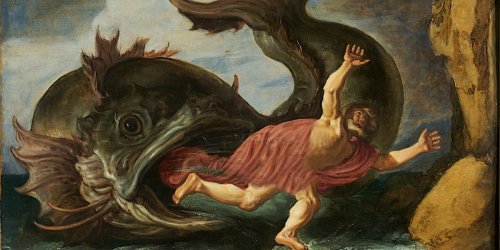
Jonah is best known for being swallowed by a large fish or whale for refusing to call Nineveh to repentance. But after being vomited up on a beach along the eastern coast of the Mediterranean Sea, Jonah headed inland to Nineveh where the whole city responded to Jonah’s call to repent.
Some claim that there is no archaeological evidence that this event took place. But up until Nineveh’s discovery in the mid-1800s, the skeptics didn’t even believe the city existed even though it was mentioned nearly 20 times in the Bible.
But Jonah’s account revealed some familiarity with Nineveh.
Jonah 3:3 describes Nineveh as an “exceedingly great city”. It took Jonah three days to walk through the city while calling its citizens to repent.
Writing on the discovery of Nineveh, archaeologist Sir Austen Layard states it was one of the ancient world’s largest cities and it would have taken several days to walk around it.
They also found several Dagan idols in the city. Dagan’s consort just happened to be the fish goddess, Nanshe, so Jonah’s peculiar arrival would have made quite a splash on the Assyrians.
But in an article entitled “Jonah in Nineveh” written over a century ago in 1892 for the Journal of Biblical Literature, Professor Henry Clay Trumbull believes there is archaeological evidence of Jonah’s brief ministry in Nineveh.
In 612 BC Babylon conquered Assyria and the City of Nineveh. In 300 BC, a Babylonian priest by the name of Berosus published three books on the History of Babylon. This included citing Assyria documents from the now long lost official records of Babylon.
Though Berosus’ books are lost they were quoted by other historians including Greek historian Apollodorus who died in 120 BC and Josephus, a Jewish historian, who died in 100 AD. In fact, Josephus claimed to have copies of Berosus’ three books.
For his books, Berosus needed to translate the Assyrian documents into Greek. In doing so he translated the name of an ancient Assyrian sea god as “Oannes.” He reported that this being emerged from the sea and brought wisdom to the people. Though some writers believe this was a reference to a Babylonian water god, Professor Trumbull wasn’t so sure.
The Greek word Oannes that Berosus used for the Assyrian god’s name is only one letter off “Ioannes” with the letter ‘I’ added at the beginning used by the Greek Septuagint for the name of the prophet Jonah. The Septuagint is the Greek translation of the Hebrew Old Testament written between 300 BC and 200 BC.
The New Testament writers also used “Ioannes” for the name of Jonah.
After consulting with Assyrian specialist Dr. Herman Hilprecht, Trumbull found that the Assyrian vocabulary had no letter equivalent for “J.”
If Berosus was trying to create the Greek equivalent of the Assyrian name for Jonah, Oannes would have certainly worked.
As for Oannes divine qualities, Professor Trumbull pointed out that the Bible tells us that Jonah “spoke the word of the Lord to the Assyrians.”
By the city’s response, they looked upon Jonah as a Divine Messenger, so it wouldn’t have been a big step to consider Jonah as being Divine as well.



 OpentheWord.org
Leave a comment