
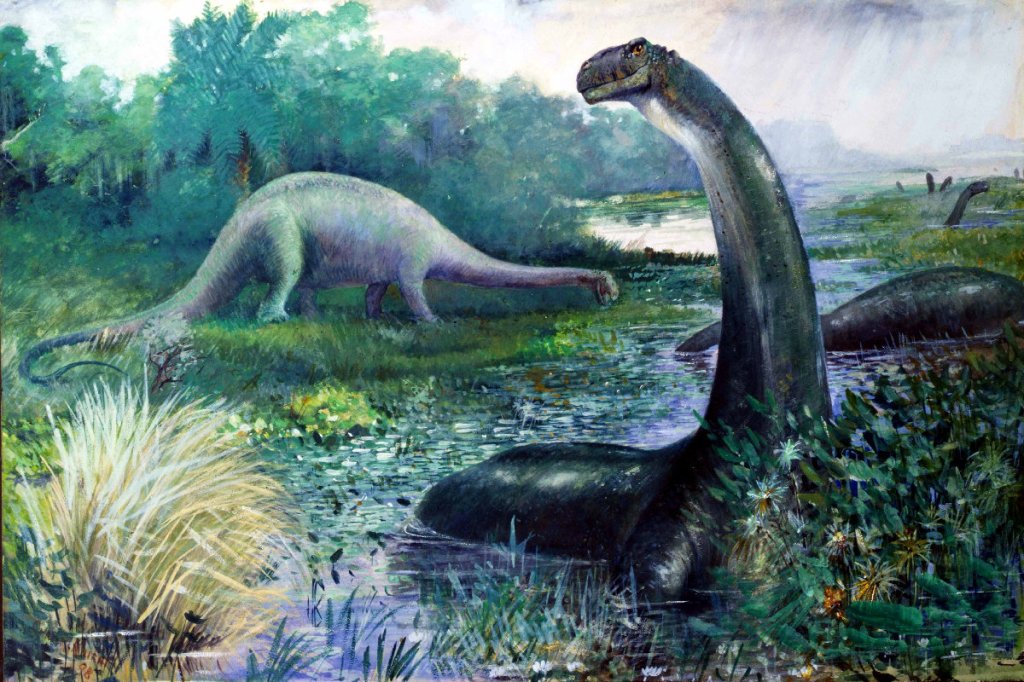
By Charles Robert Knight , 1895, Wikipedia, Public Domain
FOLLOW OUR PODCAST ON (search opentheword):
Podcast Notes:
ESPAÑOL: Lo que Job nos dice sobre la Edad de Hielo, los dinosaurios y el Consejo Divino
The Book of Job is the oldest book in the Bible. Many believe it was written shortly after the worldwide flood and before the Tower of Babel recorded in Genesis chapter 11.
Job probably lived in the time of the genealogy listed in Genesis 10. This meant his neighbors may have been people like Peleg, Joktan and Uzal.
While Job is most famously known for dealing with the age old question of suffering, it also paints a picture of a different world.
Job and the Ice Age
One of the more fascinating aspects of the Book of Job is that it talks about ice and cold more than any other book in the Bible.
Not only does it speak of ice, but it also does in an unusual way.
In Job 37:9-10 we read:
Out of the South comes the storm.
And out of the North comes the cold
From the breath of God ice is made
And the expanse of the water is frozen.
Other Bible versions translate the Hebrew word for expanses as “broad waters.” This refers to massive bodies of ice. Since Job lived in the Middle East, where did the idea of a bro;ad expanse or sea of ice come from?
But Job doesn’t stop there. Two chapters later, it talks about the quote waters became hard as stone and the face of the deep being frozen (Job 38:30).
The Hebrew word “tehom” refers to deeps, abyss and great quantities of water. This verse talks about thick quantities of ice, miles deep.
Dr. Henry Morris, founder of Institute of Creation Research, believes Job was describing the Ice Age when glaciers covered parts of the Northern Hemisphere including much of Canada, Russia and Europe.
It’s believed the ice was one to two miles high (three to four kilometers) and and in North American the ice cap extended down to Wisconsin and New York City.
One of the biggest problems of the ice age is finding a reasonable explanation for where all the water came from to cover nearly a third of the earth with a thick bed of ice.
For the ice to move out from the Arctic, two things needed to take place. First there needed to be a cooling. It’s estimated that the summer temperature in the US would have averaged around 58 F.
It also required a dramatic and rapid increase of water. Scientists can provide no reasonable explanation of how this happened, other than it did.
But its no coincidence that Job describes this ice age showing up shortly after the world wide flood had taken place.
This would not only have cooled the earth, but it also provided the massive quantity of water needed to cover nearly a third of the earth’s surface with ice caps two miles high.
But it doesn’t stop there.
Job and Behemoth, the dinosaur?
The Book of Job mentions a beast that many believe describes a dinosaur.
God talked about a creature called Behemoth to show Job how inadequate he was because only God could control this creature.
According to Job 40, Behemoth was a land creature that lived near water. It was a plant eater. It was massive in size, powerful and fearless.
Some believe this was referring to a crocodile or a hippopotamus, but the book of Job does an interesting thing, that shows it wasn’t.
It provides a unique description of Behemoth’s tail.
We read:
Its tail sways like a cedar; the sinews of its thighs are close-knit. Its bones are tubes of bronze, its limbs like rods of iron. (Job 40:17-18)
Middle Eastern Cedars grow upwards of 60 feet or taller and the Bible makes several references to their size 2 Kings 19:23 and Isaiah 2:13.
When Behemoth’s tail is compared to a cedar, you don’t think of a Cedar when it’s a five foot sapling. No, you envision a tall full sized adult tree.
There is nothing alive today that comes even close to having a tail that could be compared to 60 foot Cedar Tree.
The only possible creatures that could fit that description would be dinosaurs.
Only a few creatures from our ancient past have a tail even remotely close to that size. This would include Sauropods, and brontosauruses who due to their size preferred water over land.
The supersaurus as an example was up to 112 feet long. It has a small head, long neck, massive body and of course long tail.
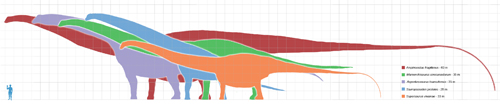
Credit: Wikipedia:Matt Martyniuk
But Job does one more interesting thing, it tells us that Behemoth’s tale swayed like a cedar tree.
Today, paleontologists agree with the Biblical description and state that dinosaurs carried their tales high.
But they didn’t always believe that.
For decades, scientists believed dinosaurs dragged their tales on the ground. Charles Knight’s famous painting of a Brontosaurus from 1897 have them do exactly that.
But that depiction was wrong and Job was right.
So if Job was describing a dinosaur, it reveals that for a brief period of time they coexisted with man.
This explains why we have stories of dragons in cultures around the world. These are based on ancients accounts of man’s encounters with dinosaurs.
Add to this they are now finding non-fossilized organic material — blood, cartilage, blood vessels — inside fossilized dinosaur bones thought to be upwards of 60 million years old.
How is that possible?
This shows us that dinosaurs are not as old as evolutionists would have us believe.
Job and the Divine Council
But the book doesn’t stop there.
With Job being the Bible’s oldest book, it speaks of an interesting feature of the Spiritual realm referred to as the Divine Council.
It shows up in the first chapter as we read:
Now there was a day when the [a]sons of God came to present themselves before the Lord, and [b]Satan also came among them. (Job 1:6)
This is literally a conclave or meeting of spiritual beings or angels. What is even more curious is that at this point Satan, the accuser, is also part of this meeting.
We find several references to this Divine council throughout the Old Testament.
It is described as the council or assembly of the Holy ones in Psalm 89:5-7. God is described as having taken His place in the divine council in Psalm 82:1.
So what is the purpose of the Divine Council?
We have a few hints.
We are told that the sons of God or angels presented themselves before the Lord.
The Hebrew word yâtsab, translated present, is used in Deuteronomy 31:14, where we are told that Jehovah asked Moses and Joshua to present themselves before the Lord in the tabernacle, so God could give Joshua a charge.
These Divine Council meetings seems to be a time, when Jehovah gives instruction to angelic beings.
In 1 Kings 22:19, we have another reference to a meeting of this Divine council, when Micaiah reports that:
“I saw the Lord sitting on His throne, with all the multitudes of heaven standing around him on his right and on his left.”
At this conclave, Micaiah reports that angelic beings actually gave suggestions on how they could accomplish a particular task that God wanted done. The one of the angels stepped forward and volunteered to do it.
In Daniel 4:17, we read that angels fulfilled the decisions made by the Divine Council.
We read:
“This decision is by the decree of the watchers, and the sentence by the word of the holy ones, in order that the living may know that the Most High rules in the Kingdom of Men.”
In this instance, the angels relayed to Daniel, via a dream, the judgment that had come down against the Babylonian King, Nebuchadnezzar by the Divine Council.
While God is all knowing and all powerful, the Lord gives angelic beings decision making responsibilities and tasks, much like He does believers.
While the book of Job suggests that Satan was initially part of this divine council, this access seems to have ended at the birth of Christ, when Satan tried to assassinate Jesus at His birth.
At this point, there was a great war in heaven and Michael and godly angels drove Satan and a third of the angels out of the heavenly realm (Revelation 12:7-12)
So Job provides some interesting insights into both the physical world and the spiritual realm.
Thanks for joining me on this podcast, and I will catch you again.


 OpentheWord.org
Leave a comment