

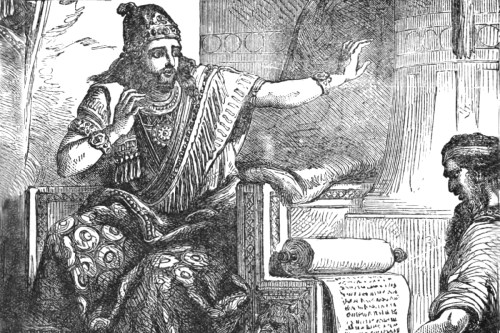
Credit: Wikipedia, Public Domain
Over the years, archaeologists in Israel have discovered signet rings worn by the politically connected and the rich. These were used to impress a person’s mark, either in wax or clay, on important documents and items to confirm ownership.
While the rings are often discovered, finding the clay or wax seal in which these images were impressed is rare. This is because they are delicate and easily destroyed or damaged.
But earlier this month, archaeologist Mordechai Ehrlich discovered a clay seal impression that was in remarkable shape, the Temple Mount Institute reports.
According to the Institute, the words written on the seal in ancient Hebrew dated to the sixth and seventh century read:
“’Belonging to Yed[a‛]yah (son of) Asayahu.’ – ליד[ע]יה (בן) עשיהו“
This caught everyone’s attention because the Bible describes a person with the same name. He was an important government official during the reign of Judah’s Godly king, Josiah.
Josiah had ordered the Jewish Temple repaired after his father, King Amon, had sent Judah down the path of idolatry.
During the renovation, the High Priest found an ancient scroll that many believe was probably the book of Deuteronomy.
It was brought before Josiah. After it had been read to him by one of the scribes, King Josiah ripped his clothes. He then sent a four-man delegation to the prophetess Huldah, to find out the significance of their discovery:
12 The king ordered Hilkiah the priest, Ahikam son of Shaphan, Achbor son of Micaiah, Shaphan the scribe, and Asaiah the king’s servant, 13 “Go, seek an oracle from the Lord for me and the people—for all Judah. Find out about the words of this scroll that has been discovered….” (2 Kings 22:12-13 NET)
Most are convinced that this clay impression belonged to the ‘son’ of Asaiah mentioned in this passage. Asaiah, who is described as the King’s servant, was one of the members of this important delegation.
Asaiah’s title tells us that he was probably one of Josiah’s key advisors.
The Temple Institute noted that it was common for sons to follow in their father’s footsteps. Yed[a‛]yah may have been working with his father or filled a governmental position after his death. Whatever the case it was a position that warranted a personal seal.
The story is equally intriguing because Josiah sought a word of the lord from a female prophetess, Huldah. God raised up both her and the prophet Jeremiah to be His voice during this critical time.
Huldah was also related to Jeremiah and it’s uncertain why Josiah chose Huldah over Jeremiah for a word.
But it may have been because, Huldah was the wife of another official in Josiah’s government, Shallum, the keeper of the clothes. Despite what his title suggests, Shallum probably managed the daily operations of the palace. Since Huldah lived in Jerusalem with her husband, it would have been an easy visit (2 Kings 22:14).
Huldah told the delegation that God still intended to bring judgment upon Judah for their sin and idolatry. But she added that since King Josiah “displayed a sensitive spirit and humbled” himself before God, he would not experience this judgment (2 Chronicles 34:22-28).
But what catches many people’s attention is the way she addressed Josiah.
“Say this to the man who sent you to me,” said Huldah (2 Chronicles 34:23 NET).
By referring to him as ‘the man’, she was giving the king no special honor because of his position. This is unusual, considering her husband’s job. But it reveals the sacred position that prophets held in Jewish society.
Though she is only mentioned twice in the Bible, one of Jerusalem’s gates was actually named after her. Called Huldah Gate, it was located along the southern wall of the city.
Archaeologists have also discovered the signet ring of “Natan-Melech, servant of the king.” This is also connected to the reign of Josiah, though indirectly.
As part of h is renewal,Josiah had ordered the removal of the horses and destruction chariots used by earlier kings to honor the sun god (2 Kings 23:11).
It was believed the sun god was carried across the sky in a chariot. These chariots were used to commemorate this daily event.
The verse states that the horses and chariots were found near the residence of Natan-Melech. This indicates that he oversaw the performance of this ritual for previous kings.
By verifying the existence of minor officials who are only mentioned once or twice in the scriptures, these discoveries confirm yet again the historical accuracy of the Bible.

 OpentheWord.org
Leave a comment