
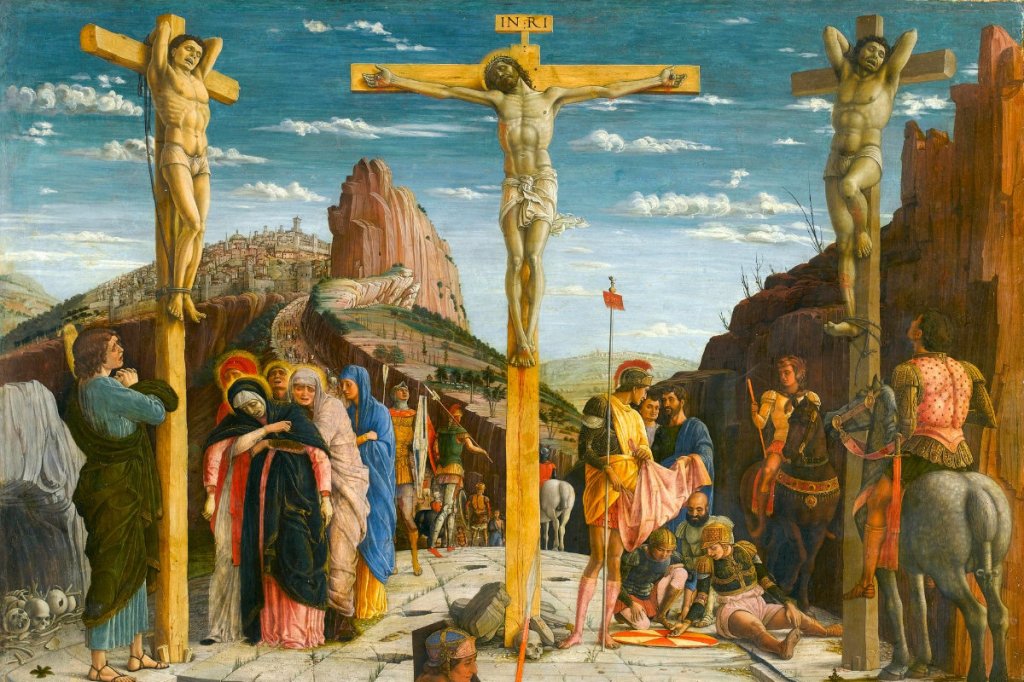

by Andrea Mantegna, 1457, Wikipedia, Public Domain
My God, my God, why have you forsaken me? (Psalm 22)
By Glenn Penner
When the early Christians underwent persecution for their faith, where did they find encouragement? What words came to their minds when crushing oppression drove them to their knee? Most often, we find, they went to the Psalms, with its varied and meaningful responses to God.
Without going into an exhaustive study of the use of the Psalms in the New Testament, it is important to briefly discuss the hermeneutical principles that the New Testament authors used.
Most frequently, the writers used quotations from the Psalms to reassert universal absolutes that have been forever settled in heaven and were found within the context of all of Scripture.
C.H. Dodd makes the assertion that in most cases when the New Testament authors quoted particular verses or sentences from the Psalms and other Old Testament books, they intended to use these verses or sentences as pointers to the whole context in which they were originally found.1
The reader was to consider the total context of the referenced passage and not simply the isolated verse or sentence as if it were a proof text.
Let’s take Psalm 22 for an example. Psalm 22 is obviously one of the major Old Testament passages that the early church saw as a testimony to the gospel facts or as disclosing the determined plan of God.
Matthew, Mark, John, Paul, and the author of Hebrews all refer to this psalm. Verses 1 and 18 are specifically quoted and verses 6, 21 and 22 are alluded to.
Hanging on the cross, knowing that His Father is not going to intervene on His behalf, Jesus is reminded of a prayer He has known from childhood, an agonized cry wrenched from the heart of another servant of God in a time of trial. A cry expressing the profound sense of divine forsakenness that the psalmist felt in Psalm 22.
Yet, by praying, He shows that He knows He is not truly or finally abandoned by God. He also knows that His Father will not intervene in His behalf to either save Him or alleviate His suffering. He struggles with the temptation of turning from the path to which God has predestined Him in order to accomplish His purposes. Deserted by His disciples, forsaken by the fickle crowds, He dies abandoned by all and assisted by none.
When Simon of Cyrene carried Jesus’ cross, he did not do so out of pity but because he was forced to. The soldiers cared nothing for their victim, except that He had a nice garment that they claimed as booty. He was taunted and ridiculed by commoner and priest alike (Mark 15:29–32).
But it is the horror of His Father’s nonintervention that causes Jesus to cry out the words of Psalm 22:1, “My God, my God, why have you forsaken me?”
Why are you so far from saving me, from the words of my groaning? (22:1)
Jesus’ use of Psalm 22 is significant. We know that the Jews had regular, formalized worship three times daily, including readings from the Law and the Prophets and singing of Psalms.
The Psalms constituted their hymn book, and most faithful Jews would have had the psalms memorized. “My God, my God,” is the beginning of Psalm 22 and the Jews at the foot of the Cross would have recognized this.
Some of them would have remembered that Psalm 22 begins in apparent defeat or tragedy, but ends in triumph. Undoubtedly some would have asked, “How can He be quoting something that has a happy ending as the life drains from him – where is the hope of which the Psalm speaks?”
Some, in Matthew’s account, mistakenly took the Aramaic “Eli, eli” to be a cry for Elijah to come and save him.
For those of His followers who stayed with Him, one wonders how much they would considered that this incident, like the psalmist’s, would ultimately end happily. Given Matthew’s account of the incident, it is obvious that some, like Jesus, recognized, as they looked around them, the prophecies in the middle section of Psalm 22 being fulfilled before their very eyes:
- “They gape upon me with their mouths…”
- “They pierced my hands and my feet…”
- “They stand staring and looking upon me…”
- “They part my garments among them, and cast lots upon my vesture.”
Hearing Jesus’ words and seeing the events unfolding around them the word of this psalm must have been running through the minds of those faithful Jews who stayed at the cross when most of Jesus’ other followers had fled.
As John witnessed the soldiers dividing Jesus clothing as He hangs on the cross, he sees a parallel to the plight suffered by the psalmist in Psalm 22:18:
they divide my garments among them, and for my clothing they cast lots.
As recorded in the psalm, the wicked loot the righteous with callous indifference and ruthlessness. The innocent victim is left helpless in his nakedness.
The words of Psalm 22:6 (together with Isaiah 53:3), “But I am a worm and not a man, scorned by mankind and despised by the people” are alluded to by Mark in 9:12. Mark refers to the fact that “it is written of the Son of the Man that He would suffer many things and be treated with contempt.” Psalm 22, as a whole, would have been prime source material to support this.
Psalm 22:21 is likely what Paul is referring to in 2 Timothy 4:17, speaking of his first defense before Nero where he was acquitted when he speaks of being delivered from the mouth of the lion
Before and during his first legal hearing before Nero, apparently Paul prayed the lament section of Psalm 22:
“Save me from the mouth of the lion! You have rescued me from the horns of the wild oxen!
And upon receiving the favorable outcome, he transformed the petition into an element of thanksgiving, namely the report of God’s intervention.
Now, as he faces his second trial, which he does not expect will end with similar deliverance, he still remains confident of God’s ability to deliver him from every evil attack and to bring him safely to God’s eternal kingdom (2 Timothy 4:18).
The words of Psalm 22 verse 22, “I will tell of your name to my brothers’ in the midst of the congregation I will praise” are quoted in Hebrews 2:12. Because of the suffering that He endured, Jesus has been crowned with glory that is to be shared with all mankind. This is what is referred to in Psalm 22:22. The suffering that Christ endured, as seen throughout the psalm, resulted in glory that will be shared with all those who He is not ashamed to call brothers (Heb. 2:11) because they, too, have remained faithful in the midst of suffering.
————————
Glenn Penner was the Chief Executive Officer of The Voice of the Martyrs in Canada. Author of “In the Shadow of the Cross: A Biblical Theology of Persecution and Discipleship” (Living Sacrifice Books, 2004) which has been translated in ten languages including Farsi, Spanish, Chinese and Russian. He taught biblical theology of persecution and discipleship in numerous countries in North & South America, Africa, Europe, and Asia. He went to his eternal reward on January 26, 2010.
Used by Permission: The Voice of the Martyrs exists to glorify God by being an effective and reliable source of information and support of persecuted Christians around the world. www.persecution.net
- C.H Dodd, According to the Scriptures. Fontana Books, 1965: 126. ↩︎




 OpentheWord.org
Leave a comment