
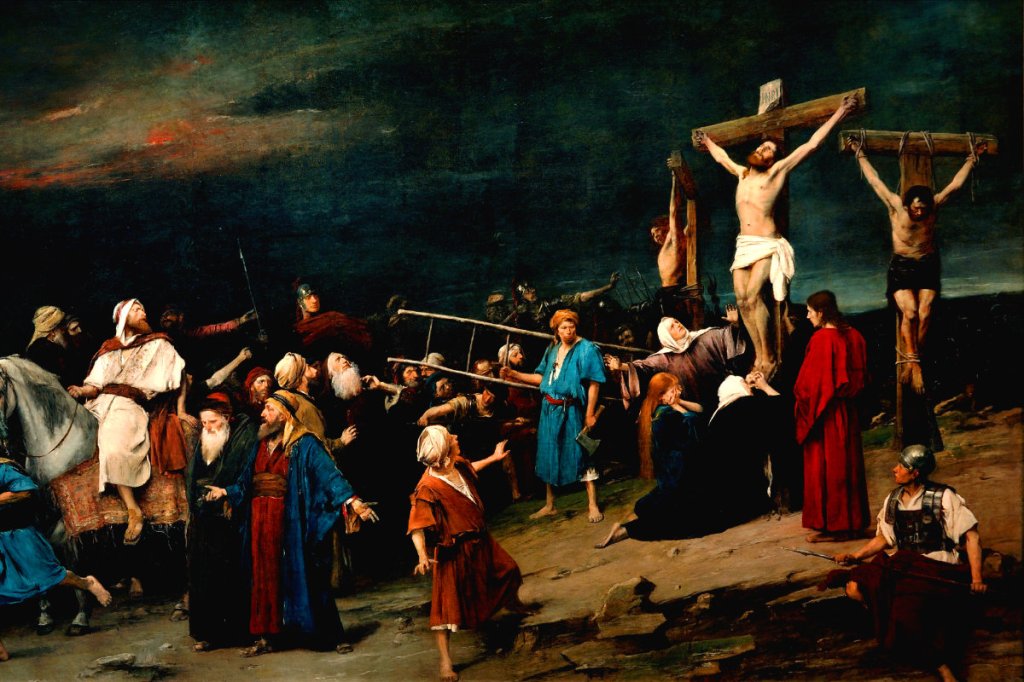
by Mihaly Munkacsy (1844-1900), Wikipedia, Public Domain
Over the years, there has been interest in determining when Christ was crucified.
According, the Biblical website, Got Questions, the most commonly accepted date is April 3, 33 AD.
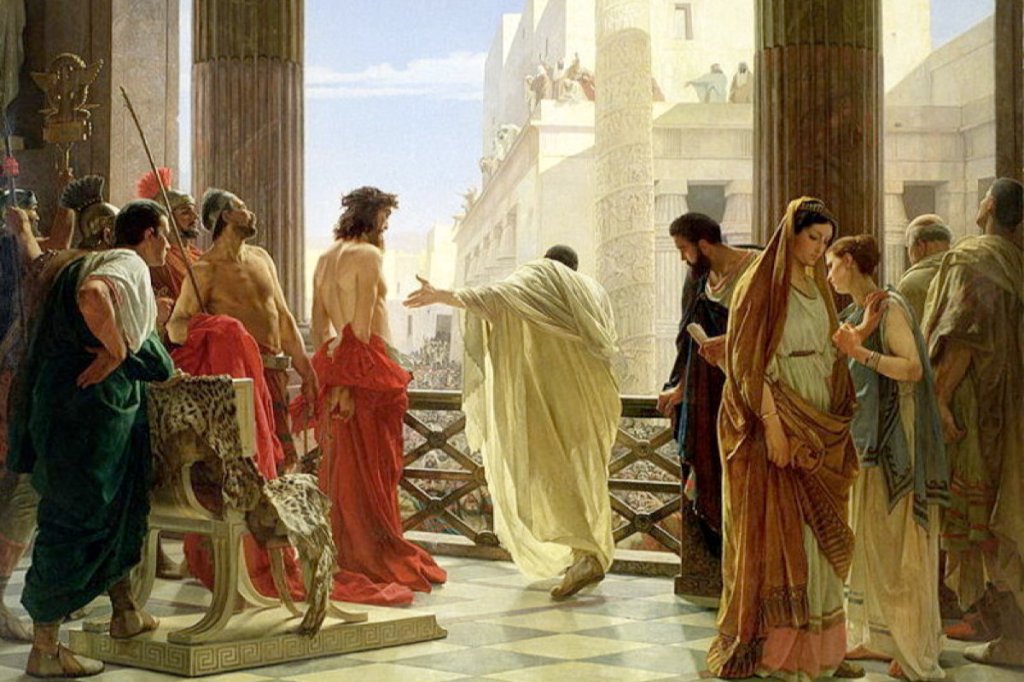
This is based on several factors. First we know that Christ was crucified on the orders of Pontius Pilate. He ruled Judea between 26 AD to 36 AD.
Secondly, Luke tells us that John the Baptist started his ministry during the 15th year of Tiberius’ reign (Luke 3:1). Tiberius became the Roman emperor in 14 AD. This means that John’s ministry started sometime in either 28 AD or 29 AD.
There is a second date of April 7, 30 AD, that is also put forward. This is based on an earlier start of John the Baptist’s ministry. It’s suggested that Tiberius’ reign started three years earlier in 11 AD. It’s argued that Tiberius co-ruled with his step father Augustus, the former emperor, for three years. This theory is not widely accepted.
Accepting the 29 AD start date for John the Baptist’s ministry, we next need to decide how long Jesus ministered.
We know from the Gospel of John, that Jesus attended at least three annual Passover feasts (John 2:13; 6:4; 11:55-57). This included the last feast in which the Lord was crucified.
Due to the extent of Christ’s ministry between the second and third Passover, many believe there was also an unmentioned fourth Passover. If this is the case, then Jesus ministered at least 3.5 years, meaning He was crucified in 33 AD.
As for the day, we know that Jesus was crucified on preparation day for the Jewish Passover. This is Friday, the day before the Sabbath (Mark 15:42).
Considering all the available information, the most likely date of Christ’s crucifixion is April 3, 33 AD.
NASA Confirms April 3, 33 AD Date
NASA recently jumped into the discussion stating it has evidence confirming the widely accepted day of April 3, 33 AD.
NASA scientists based this on a blood moon that appeared in Judea on the day Christ was crucified.
“Astronomical models suggest that a lunar eclipse turned the moon red over Jerusalem on Friday, April 3, 33 AD — a date many scholars tie to Jesus’ death.” writes Marrissa Matozzo in her article for the NY Post.
Yet, when we read the Gospels there is no mention of a blood moon occurring at Christ’s crucifixion.
For that connection, NASA points to a passage in the Book of Acts.
After the Holy Spirit fell on the Day of Pentecost, Peter quotes from Joel (Joel 2:28-31) to explain what happened.
Peter starts off quoting Joel 2:28, “I will pour out a portion of my spirit in those days, and they shall prophesy.” By doing so, Peter seems to be tying the Pentecost outpouring to Joel’s prophecy.
But Peter doesn’t stop there. He continues citing Joel’s prophecy (2:31) stating, “The sun shall be turned to darkness, and the moon to blood, before the coming of the great and splendid day of the Lord” (Acts 2:20).
Many believe that this is prophetic, looking ahead to the second coming of Christ. But others suggest that Peter is actually pointing back to the crucifixion of Christ.
This would imply there was a blood moon and the darkening of the sun at Christ’s crucifixion?
The Gospels do not mention a blood moon at Christ’s crucifixion. But Matthew adds that the sun turned dark for three hours that day (Matthew 27:45), partially fulfilling Joel’s prophecy.
But by quoting Joel, Peter seems to imply that there was also a blood moon at Christ’s crucifixion?
While the Gospels did not mention it, NASA writes that other Christian texts did.
NASA quotes a passage from the apocryphal book, the Report of Pilate, which says there was a blood moon:
“At his crucifixion the sun was darkened; the stars appeared and in all the world people lighted lamps from the sixth hour till evening; the moon appeared like blood.”
Was the author citing a known fact to legitimize his forgery? Who knows.
But with NASA confirming a blood moon at the crucifixion, we can reasonably presume Peter was implying the same thing.



 OpentheWord.org
Leave a comment