

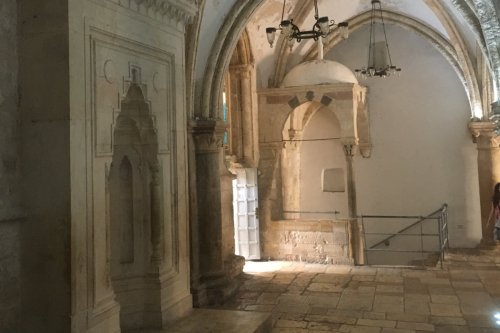
In the lead up to Christ’s crucifixion, Jesus and the 12 disciples met in the large second story room of a building in Jerusalem where they ate their last supper together. It was also where they celebrated the first communion.
This is the same upper room, where the 120 disciples gathered after the Christ’s resurrection and where the Holy Spirit fell on the Day of Pentecost.
For several centuries, a second story room in a building located just outside old Jerusalem’s ancient wall has been identified as the location of this important room.
Called The Cenacle, tradition states that King David was buried in the room located on the first story. But if this was true, undoubtedly Luke or one of the other Gospel writers would have mentioned that important detail.
Recently researchers with the Austrian Academy of Sciences (ÖAW) and the Israel Antiquities Authority (IAA) uncovered what is described as graffiti that had been scratched onto the wall by visitors over the centuries.
Many of these inscriptions were previously known but were so worn they were indecipherable. According to CBN, recent technology has enabled researcher to see nine drawings and read 30 inscriptions.
Many of these were dated to between the 14th and 16th centuries, when the building was a popular pilgrimage site for Christians.
This included:
- Symbols representing Christ as the “Lion of Judah” and “Agnus Dei,” the Lamb of God;
- The name of German pilgrim, Johannes Poloner, who visited the Israel and Jerusalem between 1421 and 1422. We know the exact date because he wrote a book about his pilgrimage;
- Several Knights and Nobles left evidence of their visit including the Coat of Arms of Styrian’s Tristram von Teuffenbach. There was also an inscription by Swiss knight Adrian I von Bubenberg,
- A phrase written in Armenian that reads “Christmas 1300” is tied to Armenian King, Het’um II, who won a battle in Syria in December 1299; and
- The image of a scorpion etched into the wall is believed to be dated to the time that Muslim leader Suleiman turned the building into a Mosque in 1523.
This was a significant room to Jesus, the disciples and as well the early church. It was home to several notable events including:
- The Celebration of Passover and the Last Supper by Jesus and the disciples (Matthew 26:17-30; Luke 22:7-23);
- Washing of the disciple’s feet (John 13:5-10);
- Resurrection appearances of Christ (Mark 16:14);
- The selection of Matthias to replace Judas (Acts 1:15-26);
- The falling of the Holy Spirit (Acts 2:1-4); and
- Where the disciples may have initially met for prayer (Acts 4:23-26). Note some ancient documents state the apostles used this room as a residence while in Jerusalem.
But it was just a room as, unlike the Jewish Temple, people were now the new residence of the Holy Spirit (1 Corinthians 6:19-20). After those initial days, the early church began regularly meeting in people’s homes (Acts 5:42).


 OpentheWord.org
Leave a comment