
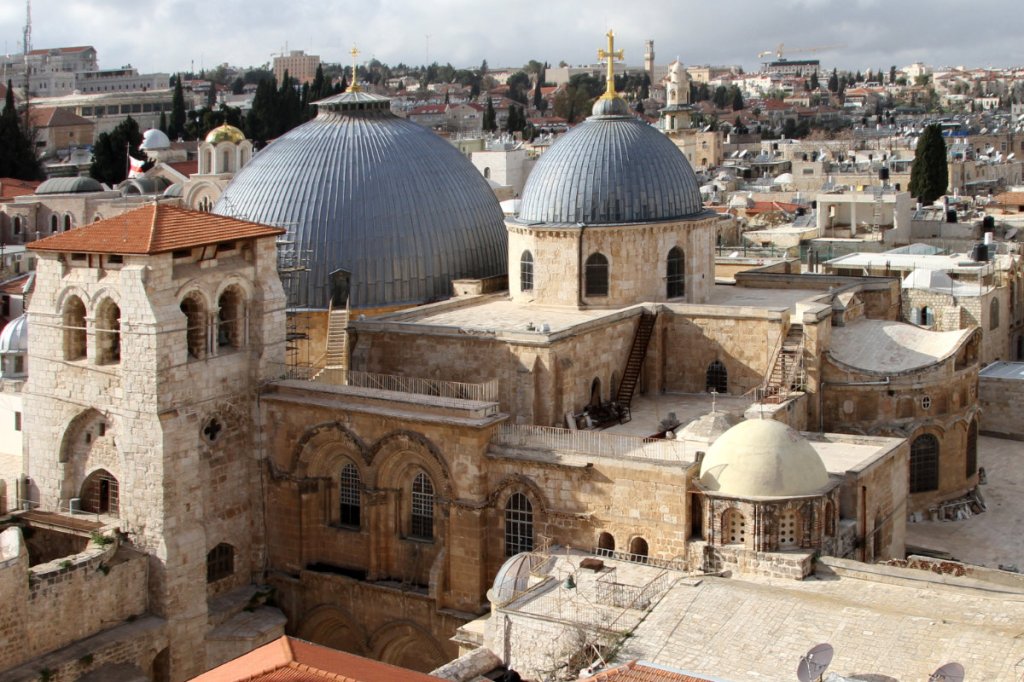
Credit: Gerd Eichmann, Wikipedia, CC BY-SA 4.0
The Apostle John described the sepulcher or burial chamber that Jesus’ body was put in after his death as “a new tomb in which no one had yet been laid” (John 19:41).
Joseph, who Matthew described as a rich man and follower of Jesus, probably had constructed the tomb for his own death (Matthew 27:57).
But with the urgent need for a grave, Joseph volunteered his sepulcher fulfilling Isaiah’s prophecy that the messiah would be buried “with a rich man in His death” (Isaiah 53:9),
Tradition states that Jerusalem’s Church of the Holy Sepulchre is built over the location where Jesus was both crucified (Golgotha) and buried. It was first identified as the site in the 4th century by Emperor Constantine’s mother, Helena. This resulted in Constantine constructing the first church.
The church building has been built, renovated, destroyed and rebuilt several times over the centuries. Today, it is co-managed by the Roman Catholic Church, the Greek Orthodox Church and the Armenian Patriarchate.
But it is a stark contrast from what the site looked like 2,000 years ago.
Because John describes it originally as being a garden, writing, “Now in the place where he was crucified there was a garden, and in the garden a new tomb” (John 19:41a).
Of course, there is no hint of any garden today.
During renovations of the building in 2022, archaeologists were allowed to dig beneath the basilica’s floor. This enabled them to examine the layers of dirt over which the church was built, the Times of Israel reports.
The excavation was led by Professor Francesca Romana Stasolla of Rome’s Sapienza University.
The group uncovered several remarkable finds.
They discovered a marble base located beneath the building (aedicule) which is the shrine built around the tomb. Because it was round, they suspected that this is actually a remnant from the first church built under Constantine.
Stasolla told the the Times of Israel, “most ancient depictions of the aedicule, which date back to the 5th and 6th centuries, describe it as circular.”
Perhaps the most significant discovery was evidence that the original site was once a garden. This was determined by an analysis that found the soil was suitable for agriculture.
But the site wasn’t always that way. It had originally been a stone quarry.
“Low stone walls were erected, and the space between them was filled with dirt,” Stasolla explained to the Times of Israel. “The archaeobotanical findings have been especially interesting for us, in light of what is mentioned in the Gospel of John, whose information is considered written or collected by someone familiar with Jerusalem at the time. The Gospel mentions a green area between the Calvary and the tomb, and we identified these cultivated fields.”
The soil analysis also found pollen from grape vines and olive trees. This indicated the type of plants that this garden once hosted.
The archaeological team added that after the quarry was abandoned, it became popular for burials. This resulted in the construction of several sepulchers. It was later transformed into a garden and continued its use as a graveyard.
These discoveries support the ancient tradition that this is where Jesus was buried.

 OpentheWord.org
Leave a comment