

Credit: PowerfulJRE, YouTube
You may not know who Wes Huff is, but he is a young Christian apologist from Toronto, Canada. He went viral in November 2024 when he completely dismantled popular YouTuber Billy Carson in an impromptu debate.
Carson, who has over one million subscribers, floats wild theories that Jesus never died on the cross, was married and that he was half alien. Carson often cites apocryphal books, like the Gospel of Barnabas, to prove his point and discredit the Bible.
Huff, who is PhD candidate, studies ancient manuscripts as his job. When Carson insinuated that the Sinai Bible does not mention the crucifixion, Huff confronted this claim,
Live on camera, Huff turned to a bookshelf behind him and pulled out a copy of the Sinai Bible and showed that it included Christ’s crucifixion.
It went downhill for Carson from there. It was so bad that Carson even threatened a lawsuit if the video of this discussion was posted.
Billy Carson has been interviewed multiple times, including once by the world’s most popular podcaster, Joe Rogan. That interview posted seven months ago has been viewed over 5.5 million times.
But after Wes Huff’s debate with Billy Carson went viral, Joe Rogan invited Huff to discuss his debate with Carson and other issues related to the Bible’s formation. Since it was posted three days ago, that interview has been viewed over three million times.
In her article for the Daily Mail, Stacy Liberatore writes that Joe Rogan, a self-professed atheist, admitted during the interview that “he may have had things wrong about the religion.”
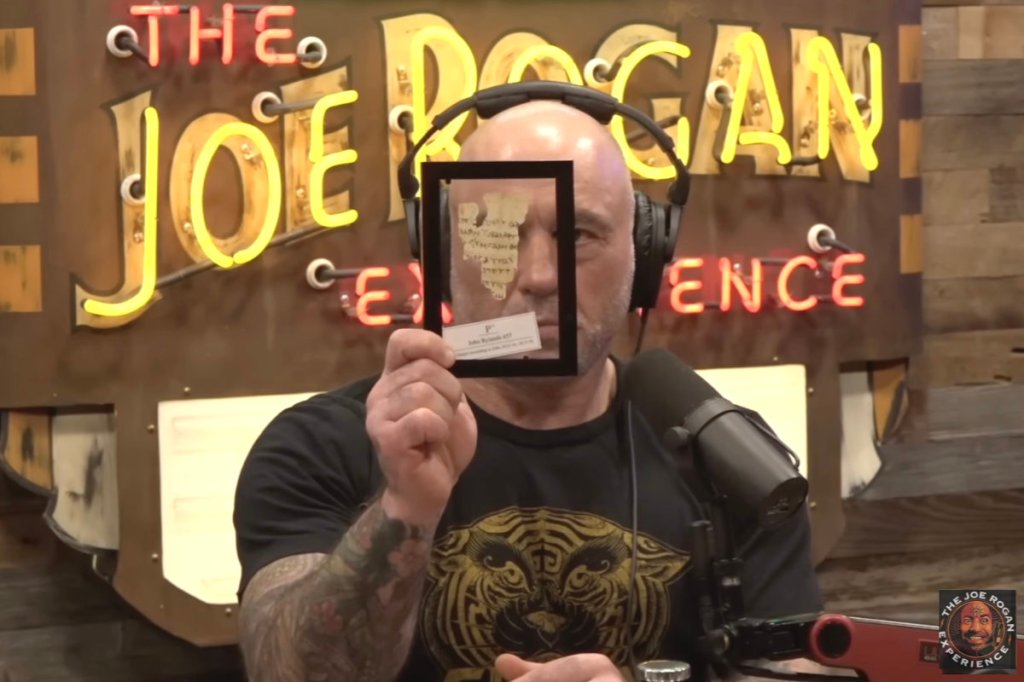
One of the interesting moments of the podcast took place when Wes Huff handed Joe Rogan a framed replica of Papyrus 52, one of the oldest known pieces of the Gospel of John, discovered in Egypt.
The fragment has writing on both sides, which identified it as Christian. Up to this point, the ancients used scrolls for their books and they were only written on one side. The Christians were the one who popularized a book format we use today that had writing on both sides.
Huff took a piece of papyrus and cut it, replicating the original and then wrote on the words from Papyrus 52 taken from John 18, and Pontius Pilate’s questioning of Jesus.
On one side, it reads, ‘Jesus says, everyone who follows the truth, who is following the truth, follows me’ and on the back Pilate’s response ‘What is truth” (John 18:37-38). Rogan seemed appreciative of this gift.
But Huff goes on to suggest this was probably part of a pocket-sized copy of the Gospel of John and explains the significance of this find. Before its discovery in the 1940s, scholars believed that the Gospel of John was written sometime in the second century long after the actual apostle John had died.
![Graffiti on a Roman wall dated to the first century. It depicts a man worshiping a crucified donkey. The words read "Alexamenos worships [his] god." It is believed Roman soldiers were mocking a Christian solder. Wikipedia](https://opentheword.org/wp-content/uploads/2013/11/jesus-wall-graffiti-rome-crucified-donkey.jpg?w=266)
The discovery of Papyrus 52 basically revealed that John wrote this gospel probably within 20 years of Christ’s death.
This is because Papyrus 52 was dated to the beginning of the second century.
This Papyrus was not John’s original gospel. Since it was in Egypt, it must have been copied, probably from a second copy or even a third or fourth copy of John’s gospel.
That copy then had to travel from Ephesus to Egypt to be recopied. So we are talking several years, if not decades after the original had been produced, which pushes the writing of John’s original Gospel well back into the first century.
Huff also discussed a piece of graffiti called the ‘Alexamenos Graffito’ created by Roman soldiers. Again it is believed to have been created at the start of the second century and depicts a man on the cross with the head of a donkey.
Below that is a man with his hands up worshiping this person and the words scrawled on the wall, ‘Alexamenos worships God,’
Though done to disparage Christianity, it’s evidence that Christ was a real person, died on the cross, and His disciples believed Jesus rose from the dead and was God.

 OpentheWord.org
Leave a comment