
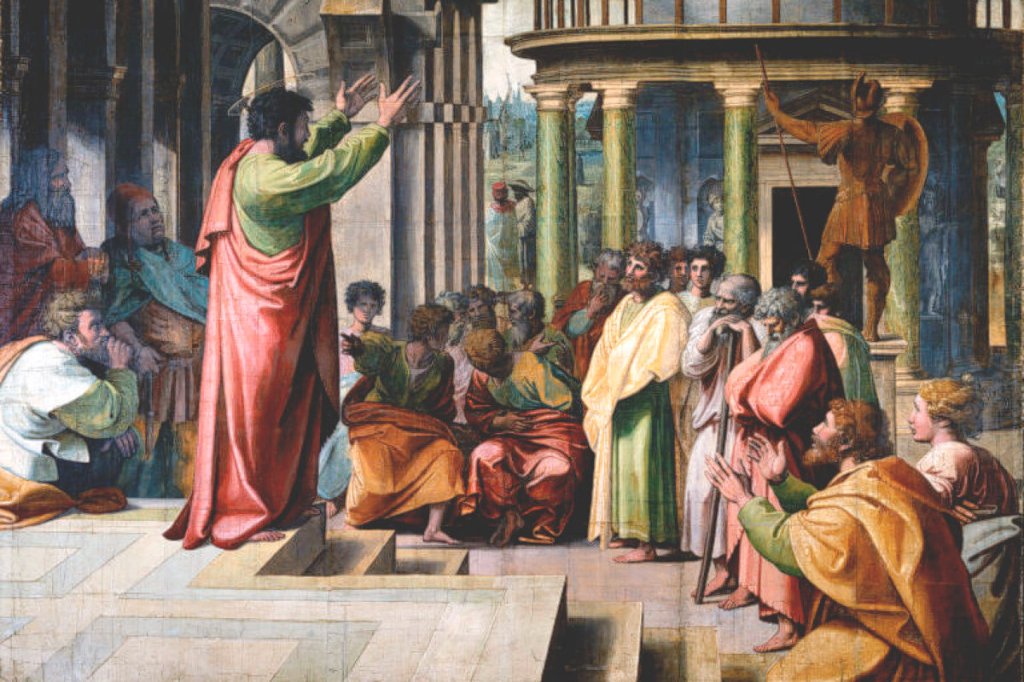
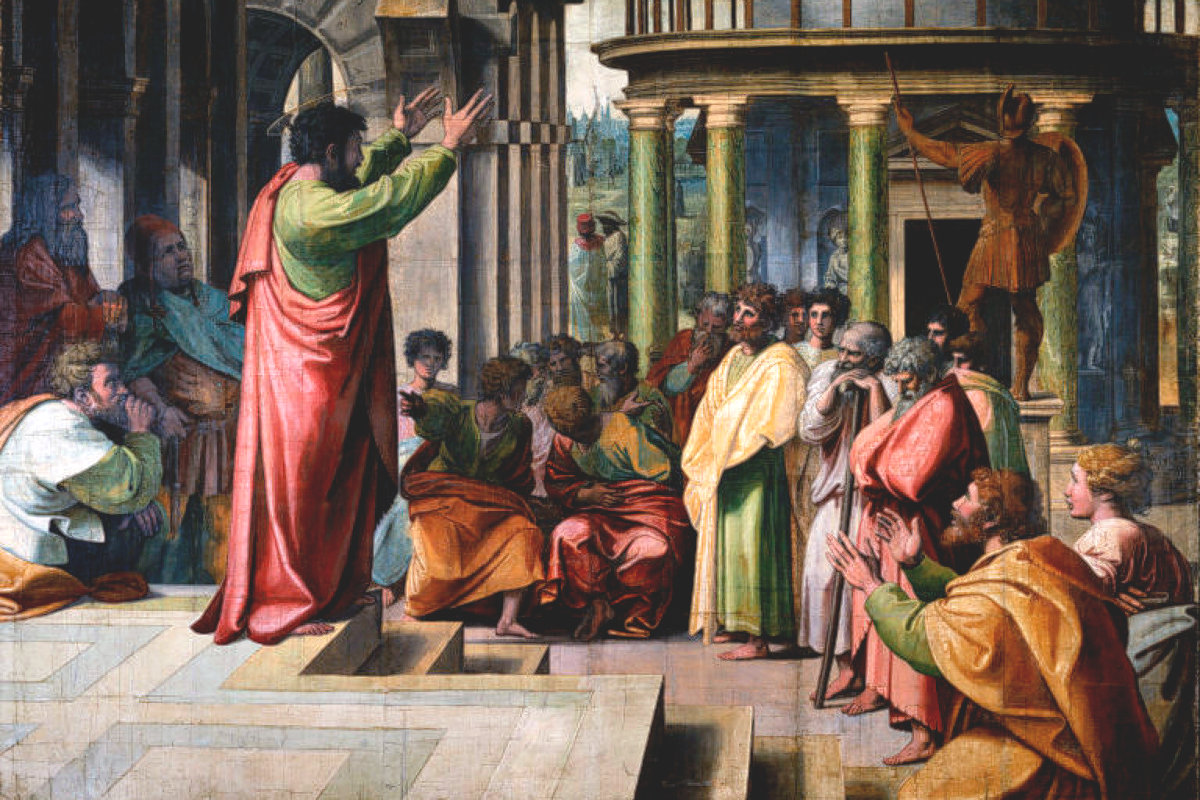
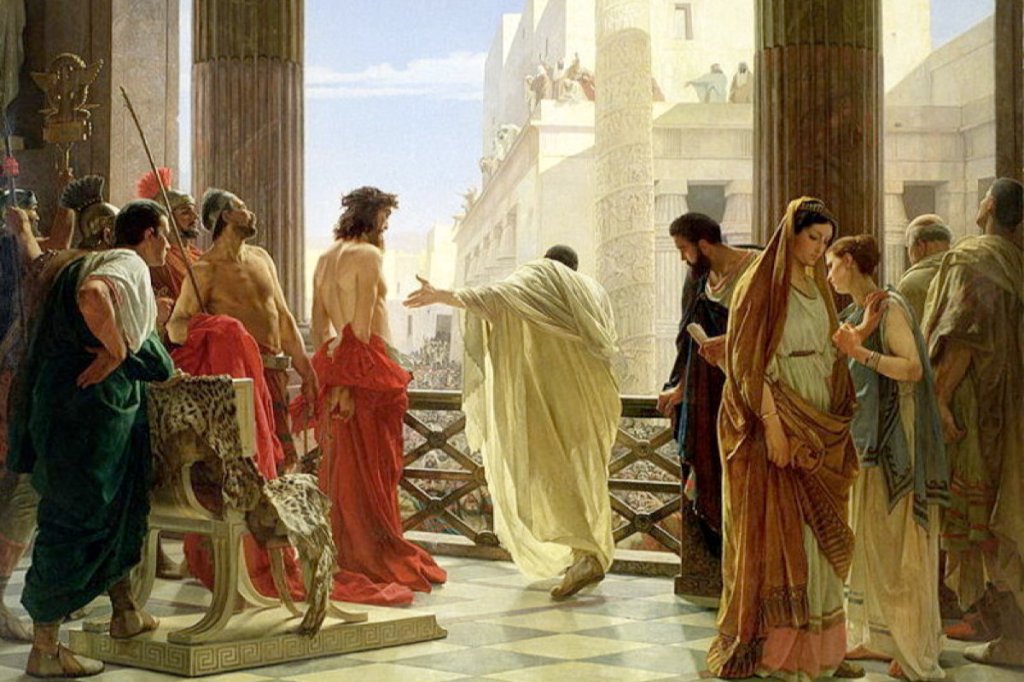
by Raphael, 1515, Wikipedia, Public Domain
The Christian Post recently reported that the San Bernardino County District Attorney has dismissed the charges police laid against Pastor Arturo Fernandez for street preaching earlier this year.
In June, Pastor Fernandez decided to preach as people were leaving a concert at the Toyota Arena in Ontario, California. Security approached Fernandez, telling him that he was on private property and asked him to leave.
Though the arena is rented by a private company, the stadium is owned by the city of Ontario. When Fernandez refused to budge stating that he was on a public property, the security called the police resulting in the arrest.
Fernandez was represented by Advocates for Faith & Freedom who argued that Fernandez’s Freedom of Religion rights guaranteed under the US Constitution were violated resulting in the dismissal of charges.

But this incident reminds me of the curious story of another street preacher, the Apostle Paul.
In Acts 17, we have the account of when the Apostle Paul spoke at the Areopagus in Athens, Greece.
Located on Mars Hill, it was a place where people gathered to argue religion and philosophy.
Paul had been invited to speak at the Areopagus after he encountered some Epicurean and Stoic philosophers while preaching in the market place (Acts 17:18).
While the Epicureans believed in gods, they didn’t believe they were interested in human affairs. The Stoics believed that God was everywhere but argued that thought superseded all emotions and that people gained an awareness of the divine through self-control.
After hearing Paul speak on this resurrected Christ, they were interested in hearing more, as it was something new to argue about (Acts 17:19-20).
Paul started off his sermon acknowledging that Athens, which was full of idols, was a very religious city (Acts 17:16, 22). But he had noticed that there was a pedestal, which had no idol on it, that was dedicated to the ‘unknown God’:
23 For while I was passing through and examining the objects of your worship, I also found an altar with this inscription, ‘TO AN UNKNOWN GOD.’ Therefore, what you worship in ignorance, this I proclaim to you. (Acts 17:23)
Using that as his springboard, Paul spoke about this ‘unknown God’ as the God of creation and His Son, Jesus, who was crucified for our sins and then rose from the dead, paving the way for salvation.
While many in the crowd scoffed at the notion of the resurrection, a few believed Paul’s message (Acts 17:32-34).
In his book, Eternity in their Hearts, Don Richardson provided more details on the history behind this altar to the ‘Unknown God,’ cited by several ancient writers.1
In the fifth or sixth century BC, Athens underwent a great plague, which they believed was the result of a curse put on them by a god, because of the treacherous actions of a former king.
The people of the city had made sacrifices to the hundreds of idols, but nothing stemmed the tide.
At this point the city leaders decided to bring in Epimenides, a renown poet and seer from the island of Crete, to help.
After he arrived, they explained to Epimenides how they had made sacrifices to all the idols but it had not stopped the plague. They asked Epimenides if there was a god not known to them, that they still needed to seek help form.
Epimenides told them to bring sheep to a hill outside the city in the early morning. This was Mars Hill, which would eventually become the site of the Areopagus.
Because it was so lush, it was expected that the sheep would instantly start grazing.
Instead, many of the sheep unexpectedly chose to lie down. Epimenides told the Athenians to build altars at the spots where sheep decided to rest and to sacrifice them to the ‘unknown God’ on these altars.
After they had done this, it is said that the plague abated within a week.
Was Paul aware of this story?
Maybe.
During his sermon at the Areopagus, Paul actually quoted Epimenides. “for in Him we live and move and have our being, as also some of your own poets have said, ‘For we are also His offspring” (Acts 17:28)..
- This included third century Greek author, Diogenes Laertius. In his book, The Lives of Eminent Philosophers, Diogenes provided the fullest description of the story. Though Diogenes does not specifically mention the altar to the ‘unknown God’, Richardson notes that Diogenes wrote “altars may be found in different parts of Athens, with no names inscribed upon them which are memorials to this atonement.” Three other ancient writers, including Aristotle in his Art of Rhetoric mentioned this story. Two of them, Pausanias’ in his Description of Greece and Philostratus in his book Appolonius of Tyana, specifically mention the altar to the ‘unknown God’ found in Athens. ↩︎

 OpentheWord.org
Leave a comment