
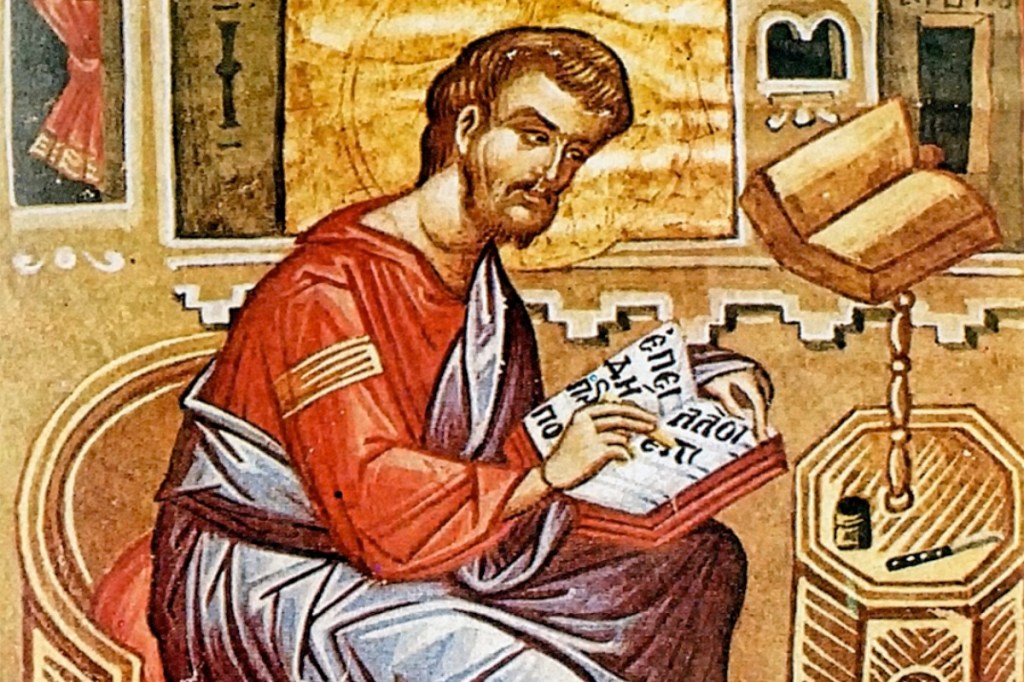
Luke wrote two letters to Theophilus, the Gospel of Luke which records the life, death and resurrection of Jesus and a second that records the Acts or history of the early church.
In the Gospel of Luke acknowledged that though he was not an eye witness to Jesus’ life, he carefully interviewed those who were.
In Luke 1:1, he explains, that “Many have undertaken to draw up an account of the things that have been fulfilled among us.” Luke acknowledged that there were other accounts written about Jesus’s life. Whether this is a reference to Mark and Matthew is hard to say, but it clearly shows that others were writing about their time with Christ.
The Book of Acts differs from Luke’s Gospel, because we know that at some point, Luke became an eye witness. While the early chapters are a result of Luke’s interviews with witnesses, there is a subtle change in Acts 16, when Luke writes “When he had seen the vision, we immediately sought to leave for Macedonia.”
The usage of ‘we’ indicates that Luke was now part of this group. One ancient manuscript used ‘we’ in Acts 11 while they were in Antioch, suggesting this may have been the point that Luke joined the group.
But by stating that he had “carefully investigated everything from the beginning” (Luke 1:3), Luke put a target on his back for those who don’t believe.
By the late 1800s, critics were stating that the Gospel of Luke and the Book of Acts were frauds and written sometime in the second century, long after these supposed eye witnesses had died.
As part of this, Sir William Ramsay, one of the greatest archaeologists of that age, decided to do archaeological work in Asia and Greece in the late 1800s and early 1900s to disprove Luke.
By the time he was done, Ramsay, the agnostic, became Ramsay the believer and actually became a Christian because of what he discovered.
“Luke is a historian of the first rank; not merely are his statements of fact trustworthy,” Ramsay said. “He is possessed of the true historic sense … in short, this author should be placed along with the greatest of historians.”
Those bashing Acts at the time, often cited Acts 17:6, where Luke writes when Paul and Silas showed up in Thessalonica, some of the Christians were dragged before the authorities and accused of acting contrary to the decrees of Caesar.
However, Luke used a specific word, politarchēs, to describe these rulers. Since there was no mention of this term being used to these authorities, the skeptics argued that Luke was wrong.
But it was Ramsay who discovered that exact word being used in Thessalonica to describe these leaders, explains Eddie Hyatt in an article on Charisma News.
“But in his archaeological excavations, Ramsay uncovered the term no less than five times in ancient carvings in the city, demonstrating beyond doubt the authenticity and reliability of Luke’s authorship,” writes Hyatt.
In fact, one description found over an archway provided the names of two politarchēs who may have actually presided over the trial of the believers.
Others have equally commended Luke’s work.
“For accuracy of detail, and for evocation of atmosphere, Luke stands, in fact, with Thucydides [Ancient Greek historian and General],” writes Auckland University professor, Edward Blaiklock. “The Acts of the Apostles is not shoddy product of pious imagining, but a trustworthy record. …It was the spadework of archaeology which first revealed the truth.”
In fact, classical historian Colin Hemer provided 84 examples of the accuracy of Luke in the last 16 chapters of Acts alone that have been confirmed by archaeology, writes Curt Blattman.
This included:
- Using the correct term, Areopagites, to describe a court official (Acts 17:34),
- Describing the judgment seat, bema, that overlooked the forum in Corinth (Acts 18:16-20),
- Naming Felix as the governor in Caesarea (Acts 23:23-24),
- Luke uses the term ‘my Lord’ to describe Caesar who at that time was Nero. It was a term that had only recently come into use (Acts 25:26),
- Luke used the correct term, bolisantes, when he described the sailors taking soundings of how deep the water was in Acts 27:28. In this account, Luke also recorded how an Angel told Paul, which he then passed on to the sailors, that their ship would soon run aground near an island (Acts 27:21-26). Luke essentially recorded a miracle and confirmed a historical fact in one account.
- In Acts 19:35, Luke used the official title, neōkoros, when he said that the people of Ephesus were the “guardian of the temple of the great Artemis.” Rome designated it as the official temple of Artemis for the region and distinguished with that designation.
- The demand by Rome that people who were imprisoned had to pay for their own keep (Acts 28:30-31).
Luke closes the book of Acts describing Paul’s two year house arrest in Rome.
30 Now Paul stayed two full years in his own rented lodging and welcomed all who came to him, 31 preaching the kingdom of God and teaching things about the Lord Jesus Christ with all openness, unhindered. (Acts 28:30 NASV)
This indicated that Luke sent his letter to Trophimus shortly after Paul’s two year house imprisonment had ended, but before Paul’s martyrdom a short time later.
During this incarceration, Paul wrote four letters. Three were to the churches at Ephesus, Colossae, and Philippi. The fourth was a letter, Paul wrote to Philemon. All four cited Paul’s imprisonment.
While under house arrest, Paul was watched by a Roman guard (Acts 28:16) and allowed to receive visitors (Acts 28:30-31), that may have included some from Caesar’s household (Phil 4:22).


 OpentheWord.org
Leave a comment