
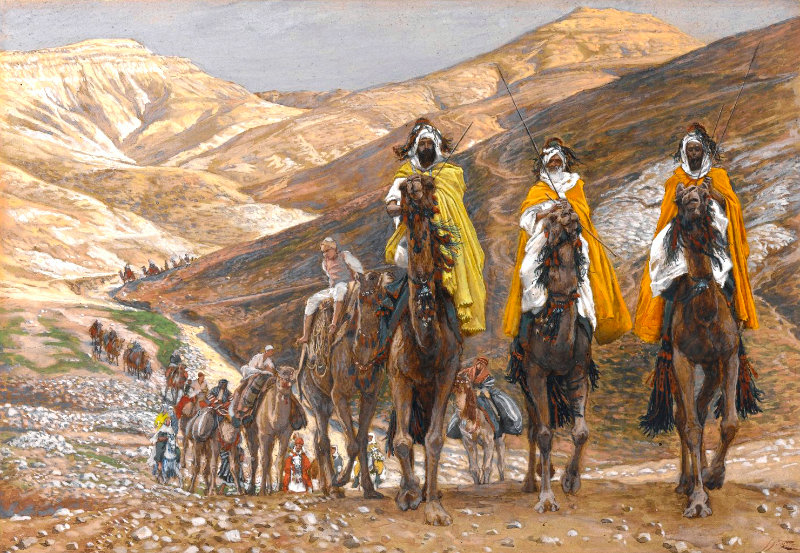
By Jame Tissot, 1890, Wikipedia, Public Domain
FOLLOW OUR PODCAST ON (search opentheword):
PODCAST
Hi, my name is Dean Smith and in this podcast, I want to discuss the magi from the East, who came to Jerusalem looking for the newborn Jewish King.
Though it has been traditionally believed there were three of them, because of the three gifts, we have no idea how many there were. But there has also been some controversy on who they were with some calling them wise men and if the Christmas songs are to be believed, kings.
In fact, historically, they were considered kings by the third century, and by the seventh century, they had even been given names, Caspar, Balthazar, and Melchior.
All three were eventually declared saints by the Roman Catholic Church, which meant they had performed miracles after they died. The Cologne Cathedral in Cologne, Germany also claims to have the bones of these three as part of its relic collection.
Over the years, backstories have been developed for the three kings. Such as Caspar, who was declared to be a King and scholar from India, who died in 55 AD at 109 years of age.
According to one Catholic website, Caspar is the patron saint of playing card manufacturers, among others, and I have no idea what a patron saint does. The Roman Catholic Church even set aside a feast day on January 6 to commemorate ole Saint Caspar.
As intriguing as all that sounds, the actual Greek word, magos, which was used to describe these visitors, along with the fact they were from the East, implies that these individuals were part of a guild of influential men who advised both the Babylonian and Persian kings.
Thayer’s Greek Dictionary describes them this way:
1a) The name given by the Babylonians (Chaldeans), Medes, Persians, and others, to the wise men, teachers, priests, physicians, astrologers, seers, interpreters of dreams, augers, soothsayers, sorcerers etc…. 1c) a false prophet and sorcerer.
Many of these magi undoubtedly served as priests in ancient Persian religions. Aside from their religious duties, they also filled a powerful political role by advising kings.
We see a glimpse of this in the Book of Daniel, when King Nebuchadnezzar had a disturbing dream and summoned his advisors to interpret it.
We read:
2 So the king summoned the magicians, enchanters, sorcerers and astrologers to tell him what he had dreamed. (Daniel 2:2).
As we see from this description, these magi had multiple specialties including casting spells and uttering prayer-like incantations to curse enemies, developing magical formulas, using the stars to predict a person’s destiny, and of course interpreting dreams.
We even see their political influence in the New Testament, when Luke used the same Greek word, magos, to describe a magician or sorcerer known as Bar-Jesus who was serving as the chief counselor to Sergius Paulus, the governor of the Island of Cyprus.
He also went by the name of Elymas, which meant wise and according to Strong’s concordance was derived from the Arabic word for Wizard.
Bar-Jesus used his influential position to hinder the governor from becoming a Christian after Paul and Barnabas showed up on the island in Acts 13.
Paul finally became so fed up with Bar-Jesus, that he publicly rebuked him, causing him to go blind. But in the course of this rebuke, Paul called him a child of Satan, deceitful, an enemy of righteousness, and one who was perverting the truth. Paul clearly associated Bar-Jesus and his ilk with the demonic realm.
So it was a bit odd to see a group of these ‘magos’ traveling to Jerusalem looking for the newborn Jewish King. Their arrival also revealed their important role in society as they brought extravagant and expensive gifts for Jesus, gold, frankincense, and myrrh. You don’t accumulate this kind of wealth without receiving a few payoffs.
These men were wealthy and undoubtedly were traveling in a large Caravan, think of a convoy of armor-plated limousines with darkened windows and a bevy of heavily armed guards wearing dark sunglasses.
I think you get the picture.
Their arrival in Jerusalem caused a stir when they began asking around if anyone knew about this new king of Israel, whose star they had seen months earlier.
We have to understand if they came from Persia it was a 1400 miles (ca. 2,253 km) journey and would have taken them months to complete, so that star had been hanging around for a while.
King Herod arranged a meeting with the ‘magos’ and after explaining why they were there, we see the influence these men had as Herod and all of Jerusalem were troubled by the Magi’s message.
Herod asked them to return to Jerusalem once they had found this king.
But what was particularly curious is that God spoke to these men in a way they would understand. First, God used a star to catch their attention.
As astrologers, the magi closely studied the movements of stars, believing they somehow impacted the destinies of men. The sudden appearance of a unique star in the heavens led them to believe a new Jewish King had been born, causing them to follow it to the newborn Christ. We see references to that in Matthew 2: 2, 9.
God also spoke to them through a dream, warning them not to return to Herod. Of course, they were renowned for their ability to interpret dreams.
So God was communicating with these magi in lingo they could understand and arranged for them to come and worship Jesus. At this point, Jesus was probably a toddler, as Joseph and Mary were now living in a house.
So why would God drag in a group of men involved in the dark arts to worship Christ?
This was in no way a validation of the occult, but I believe they were plunder from an unseen war that had just taken place in the spiritual realm.
We have a record of the battle in Revelation chapter 12, where we read how a red dragon, who was none other than Satan, had enticed a third of the godly angels to join him, attacking a woman who was just about to give birth, and conspired to kill the child.
We read:
“And his tail swept away a third of the stars of heaven and hurled them to the earth. And the dragon stood before the woman who was about to give birth, so that when she gave birth he might devour her Child. (Revelation 12:4)
Many believe that this child was none other than Jesus.
As all this was occurring in the spiritual realm, Mary and Joseph would have been blissfully unaware of what was taking place.
They only saw glimpses of the raging spiritual battle, when Joseph was warned in a dream to go to Egypt to escape Herod’s attempt to assassinate Jesus.
We know from the Christmas story, that after the magi avoided Herod on their return home, Herod consulted with his advisors which included those familiar with the Hebrew scriptures and determined that the new king of the Jews would be born in Bethlehem.
When Herod ordered all the boys under the age of two in Bethlehem to be slaughtered, it was a demonstration that Herod was just a mere a pawn in this spiritual war whom the Red Dragon had just played in a failed attempt to kill Christ.
But this open spiritual rebellion against the Kingdom of God resulted in a dramatic confrontation that saw Michael, the archangel, lead an angelic army driving Satan and his minions from heaven.
We read:
7 And there was war in heaven, Michael and his angels waging war with the dragon. The dragon and his angels waged war, 8 and they did not prevail, and there was no longer a place found for them in heaven. 9 And the great dragon was thrown down, the serpent of old who is called the devil and Satan, who deceives the whole world; he was thrown down to the earth, and his angels were thrown down with him. (Revelation 12:7-9 NASV)
Satan had just suffered a massive and humiliating defeat.
I wonder if the magi, who were involved in the occultic arts, were simply the plunder that God collected from the satanic realm after this massive spiritual battle in the heavens.
It was the ultimate display of God’s power and supremacy over the satanic realm, as He led those described as the sons of the Devil to bow their knees to Jesus and worship Him (Matthew 2:11).
This leads me to believe, that they were probably the first Gentiles to become believers in Jesus.
Thanks for joining me on this podcast, and I will catch you again.

 OpentheWord.org
Leave a comment