
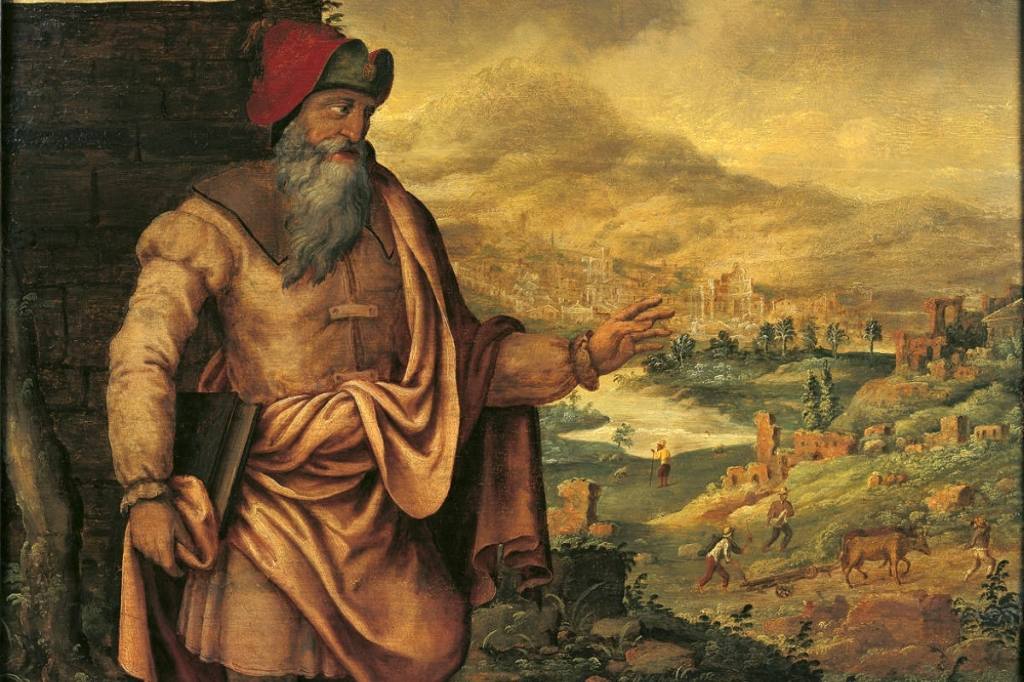
By Maarten van Heemskerck, (1560-65), Wikipedia, Public Domain
“Go, say to this steward, to Shebna the palace administrator: 16 What are you doing here and who gave you permission to cut out a grave for yourself here, hewing your grave on the height and chiseling your resting place in the rock? (Isaiah 22:15-16 NIV)
There is a strange warning in the book of Isaiah, where the prophet has a word for an important bureaucrat in King Hezekiah’s government, Shebna.
He was referred to as Hezekiah’s steward (ăšer ˓al habbāyt) or palace administrator. He was in charge of the treasury and the King’s palace and was subsequently the highest-ranking official in Judah at that time and would have had an inordinate amount of influence in Hezekiah’s government.
The prophetic word even implies some skulduggery suggesting that Shebna had secretly ordered the construction of this elaborate tomb without receiving proper permission.
If he was willing to do this, what else was he involved in?
It seems that Shebna was in stark contrast to Hezekiah who was considered one of Judah’s more righteous kings (2 Kings 18:5).
In the prophetic word, Isaiah also tells Shebna that he would be humbled and replaced (Isaiah 22:18-19), and maybe it was the exposure of the secret tomb that ultimately led to Shebna’s demotion.
Years later, when the Assyrian King besieged Jerusalem a new palace administrator or steward, Eliakim, was sent out to negotiate. But interestingly he brought with him a subordinate, Shebna, to record the negotiations. If this is the same Shebna, he is clearly in a subordinate role (Isaiah 36:22).
In addition, Isaiah specifically addresses the elaborate tomb carved out of the rock that Shebna had built for himself, stating that instead he would be dragged off into captivity and die in a foreign land (Isaiah 22:18).
The irony in all this is that in 1870 archaeologist Charles Clermont-Ganneau may have actually discovered Shebna’s tomb.
It was located in a cave overlooking Jerusalem and Kidron Valley and the prophet Isaiah specifically refers to Shebna’s tomb as being located in the heights (Isaiah 22:16).
While the kings were typically buried within the walls of Jerusalem, the graves of the elite were found in the hills overlooking the city.
The tomb also had an inscription that read:
“This is [the sepulcher of …] -yahu who is over the house. There is no silver and gold here but [his bones] and the bones of his slave-wife with him. Cursed be the man who will open this.”
Though the name is incomplete the last few letters ‘yahu’ would have been part of his name, as ‘Shebna’ was a shortened form of ‘Shebnayahu.’ Researchers studying the script state that Shebna would have fit perfectly in the damaged space.
But equally significant is the inscription gave the individual the same Hebrew title, ăšer al habbāyt, which was used to describe Shebna’s role in the Bible, leading many to suggest that this is the same official that Isaiah railed against.
Despite ordering the construction of the tomb and its inscription in a location typically reserved for Jerusalem’s elite, Shebna would never use the tomb himself.
Today, it is part of a home in Jerusalem.
READ: Top Ten Discoveries Related to the Book of Isaiah AND Has The Tomb of Shebna Been Discovered?

 OpentheWord.org
Leave a comment