
I was recently at a prayer meeting in home of friends, where we prayed for several people who are sick. As is often the case, most were not present when we prayed for them.
But as we study Jesus’ healings in the Gospels, the overwhelming majority were ‘close proximity’ healings. Jesus was physically present.
Most were healed as Jesus laid hands on them as we read in Luke 4:40. This was Christ’s most common method of healing.
But not always. Perhaps, the strangest involved the woman with the issue of blood, who touched the hem of Christ’s garment and was instantly healed. In that instance, Jesus actually felt the healing virtue leave His body, as it was pulled out by the woman’s faith (Luke 8:46).
This transference of the Holy Spirit’s healing power may explain why laying on of hands was Christ’s preferred method.
There were also times, when Jesus healed people with His words. But again, they were close enough to hear what Jesus spoke over them.
This includes Peter’s mother in law. After Jesus entered her room, He “rebuked the fever, and it left her” (Luke 4:39).
But perhaps the strangest involved Lazarus, who was raised from the dead (John 11:38-44). Lazarus been dead for a few days. He was now wrapped in grave clothes and laid out on a stone shelf inside a closed tomb.
When Jesus arrived the Lord told them to roll away the stone. Then the Lord “called in a loud voice, ‘Lazarus, come out!’”
Why did the Lord shout? Did Lazarus’ dead body need to hear that command to ‘come out’? It seems so.
Jesus’ Three Long Distant Healings
But there were three occasions when Jesus healed people through long-distance faith declarations. In these three instances, Jesus was not physically present when the healing took place.
In an article for Evangelical Focus, Mark Arnold spoke about the unique nature of these healings.
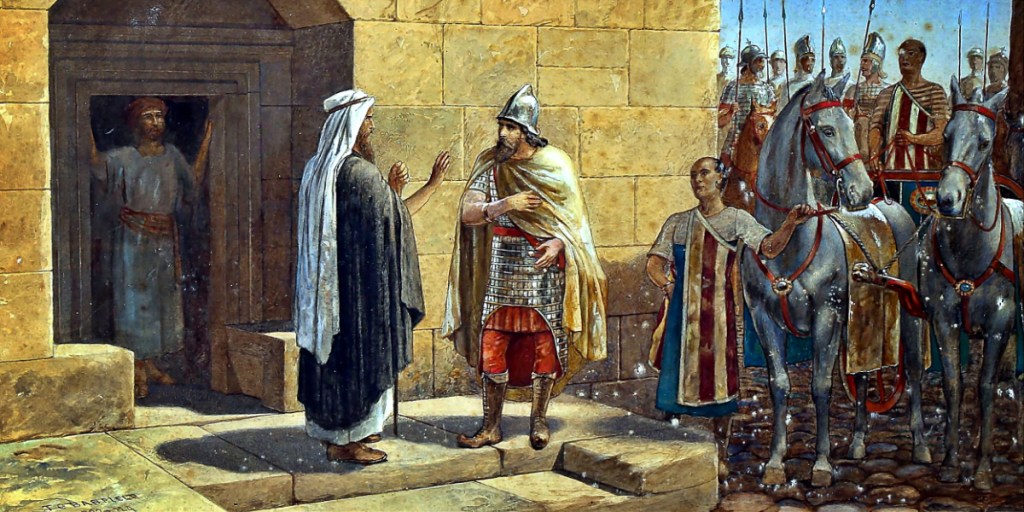
This included the healing of the Centurion’s servant in Matthew 8:5–13. Jesus was in Capernaum, where the Centurion lived, but his house was a distance away.
When Jesus offered to go to the man’s home, the centurion said “just say the word, and my servant will be healed.” Jesus replied, “Go; it shall be done for you as you have believed.”
Then while Jesus was Cana, a Royal Official living in Capernaum (20 miles away) asked the Lord to heal his dying son (John 4:46–54). Jesus simply declared, “Go; your son will live”.
Later the government official determined his son’s fever broke, at the moment Jesus declared those words.
Then there was a gentile woman in Tyre who asked Jesus to heal her daughter, who was being oppressed by an evil spirit. The daughter was not present at the time.
After a brief testing of the woman’s faith, Jesus declared “O woman, your faith is great; it shall be done for you as you desire” (Matthew 15:28).
As Arnold explains, “In these instances, the person asking for help demonstrated a strong understanding of Jesus’ spiritual authority, believing his power was not bound by him needing to be physically present with the person needing to be healed.“
For the Centurion this made complete sense. As a man under authority, he understood when giving orders, he did not need to be physically present to ensure it was obeyed.
Arnold also points out that two of these people experiencing long distance healing were gentiles.
“Jesus demonstrated that his salvation and power extended beyond the borders of Israel and to those often excluded by the religious establishment,” Arnold explains.
But more importantly, Jesus demonstrated long distance healing for our benefit. That same authority (through Christ) and power (through the Holy Spirit) is available for all of us today,
“Just as the The Syrophoenician Woman, the Centurion and the Royal official petitioned for their loved ones from afar,” Arnold writes. “These accounts encourage us to pray for people anywhere, trusting that God is present everywhere.“

 OpentheWord.org
Leave a comment