
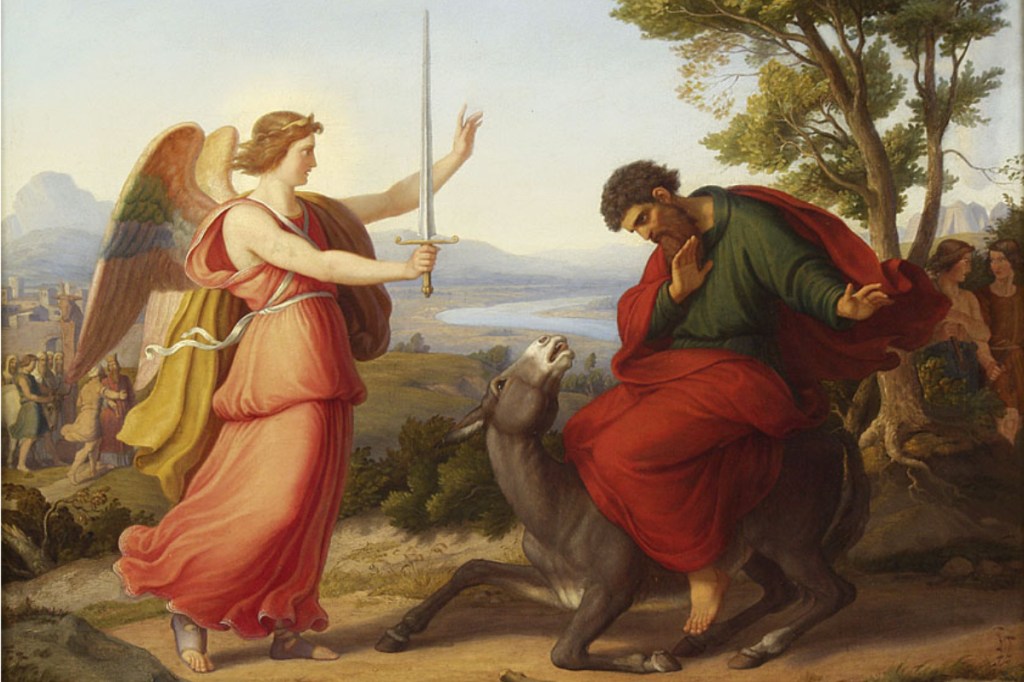
by Gustav Jäger, 1836, Wikipedia, Public Domain
How shall I curse, whom God hath not cursed? or how shall I defy, whom the Lord hath not defied? — Numbers 23:8
By Rick Renner
I want to share with you about an interesting character in the Bible who actually tried to curse God’s people. He attempted unsuccessfully to do it multiple times — which proves that the devil cannot curse what God has blessed ! The example of Balaam shows that witchcraft, divination, and curses simply have no impact on people who are walking with the Lord.
Let’s learn more about this man named Balaam. There are numerous sources that describe his origin, but the Bible is our most solid source, and it identifies Balaam in Numbers 22. Balak, king of the Moabites, heard that Israel was approaching his territory. Balak feared that his kingdom would be defeated by Israel’s army. Verse 5 states that Balak “…sent messengers therefore unto Balaam….”
Balaam’s lineage is difficult to determine because the Bible doesn’t tell us where his family came from. The greatest bulk of what is known about Balaam comes from ancient Jewish commentaries. These ancient sources affirm that he was well known in his time and that he played an influential role as a diviner and soothsayer. One Alexandrian commentator described Balaam as a “master” diviner and foreteller of great renown.1
The city of Alexandria was a long-time center of Egyptian witchcraft, sorcery, wizardry, enchantments, incantations, magic, and spells — and the educated Jewish scholars from this city were very familiar with these practices. They had seen occult practices during their sojourning in Egypt, and they knew the difference between a mere apprentice and a master of sorcery. Thus, for an Alexandrian Jew to write that Balaam was renowned for his dark skills indicates Balaam possessed a profound level of expertise as a master sorcerer.
The most famous Jewish scholar was Josephus, whose writings are still considered the most accurate extra-biblical historical account of Jewish history ever written. He wrote, in effect, that Balaam was among the greatest of the prophets at that time.2 That is a remarkable statement, since Balaam lived during the same time as the prophet Moses. But whereas Moses was an instrument for the power of God in the earth, Balaam was an instrument through which the kingdom of darkness found access in the earthly realm.
The use of the word “prophet” in the writings of Josephus should not be misunderstood. In this context, “prophet” does not refer to a spokesman of God, such as Moses or Elijah, for Balaam’s practices were diametrically opposed to the way God manifested Himself through His prophets. In fact, Deuteronomy 18:10-12 and Leviticus 19:26 enumerates God’s prohibitions regarding occult practices, such as those practiced by Balaam. Josephus simply used the word “prophet” in a general sense to denote one who was able to foresee the future. Pagans often used this word “prophet” to denote anyone who was a vocal instrument of the spirit realm. In this sense of the word, Josephus’ description of Balaam was very much in line with what the Bible tells us about this controversial “prophet.”
According to Scripture, Balaam was a diviner who operated with powers of divination (see Numbers 22:7; 23:23). Other common names for “diviners” include foretellers, seers, soothsayers, consulters of familiar spirits, enchanters, necromancers, wizards, witches, voices through which the spirit realm speaks, mediums, and clairvoyants.
The ancient world was full of diviners, but it seems none was more notable than Balaam during his time. Balak’s own kingdom of Moab almost certainly had a plethora of diviners. But because none was capable of cursing Israel, he sent emissaries nearly 400 miles to plead with Balaam to come and curse the people of Israel on his behalf.
If diviners enjoyed a past record of success, they could demand high prices for their divination, and Balak knew that hiring a sorcerer as notable as Balaam would be very expensive. However, the Moabite king was prepared to pay whatever sum was required to coax Balaam to come and curse Israel. Therefore, he sent his emissaries to Balaam, offering to “promote” him with “great honor” (see Numbers 22:17). Verse 18 implies that Balak was willing to pay Balaam a great fortune — perhaps even “a house full of silver and gold” — to perform this service of cursing a nation of people.
We know Balaam was revered as a great diviner and soothsayer, known far and wide for his abilities to bless or curse, because in Numbers 22:6 (NKJV), Balak told Balaam, “…For I know that he whom you bless is blessed, and he whom you curse is cursed.” Balak was certain that Balaam would be able to curse Israel — but Balaam could not do it.
Balaam tried three times to speak a curse upon Israel, yet he did not have the power to do it. Balaam finally was forced to tell Balak, “How shall I curse, whom God hath not cursed? Or how shall I defy, whom the Lord hath not defied?” (Numbers 23:8). Scripture tells us that every time Balaam opened his mouth to speak a curse, a blessing came out instead (see Numbers 23:10-12). Finally, after failing repeatedly to place a curse on Israel, Balaam conceded that divination was no match for the power of God. It was at this point that he told Balak, “For there is no sorcery against Jacob, neither is there any divination against Israel…” (Numbers 23:23).
It was simply impossible for a curse to be pronounced where God had pronounced a blessing! It was true then, and the same is true today.
Balaam serves as a reminder of God’s divine protection. Balaam — one of history’s most famous sorcerers — was unable to penetrate God’s protective shield that held fast and secure around His people. Even today, there are some who allege that people involved in the occult have the power to curse believers. However, Scripture clearly teaches that no one has the power to curse what God has blessed. The story of Balaam serves as a perpetual reminder that what God has blessed is blessed, and that fact cannot be reversed.
If you are in Christ and walking in obedience to God’s Word, you are safe, secure, and sealed in the protective blood of Jesus — and the power of that divine protection can never be breached by someone operating under, or in cooperation with, the powers of Satan. You need never be fearful of any curse assailed against you or your loved one, no matter how dark or “powerful” the vessel through which the curse tries to come. The occult has never been, and will never be, a match for the power of God that is inside a believer. This is precisely why the apostle John wrote, “…Greater is he that is in you, than he that is in the world” (1 John 4:4)!
I encourage you today to cast off fear of the devil or fear of anything that anyone has told you about the possibility of being cursed. If you are in Christ, you are the blessed of the Lord — and what God has blessed, no one can curse!
_________________________
Rick Renner is a prolific author and a highly respected Bible teacher and a leader in the international Christian community. He is the author of more than 30 books, including the bestsellers Dressed To Kill and Sparkling Gems From the Greek.
In 1992, Rick and his family moved to what is now the former Soviet Union. Two years later, he and his wife Denise founded the Riga Good News Church in Latvia before moving on to Moscow in 2000 to found the Moscow Good News Church. In 2007, the Renners also launched the Kyiv Good News Church in the capital of Ukraine. Today, Rick serves as Bishop for this group of churches.
In addition, Rick and Denise pioneered a Bible school, and a ministerial association that serves thousands of Russian-speaking pastors throughout the former USSR as well as parts of the Middle East.
Rick also founded Media Mir, the first Christian television network established in the former USSR. Its broadcast capabilities via terrestrial stations in Russia, Ukraine, Mongolia, Estonia, Poland, Latvia, Armenia, Georgia, and Moldova, and as well by satellite means millions of people are reached with these messages. It has since expanded into book publishing and managing social media accounts. Website: Renner.org


 OpentheWord.org
Leave a comment