
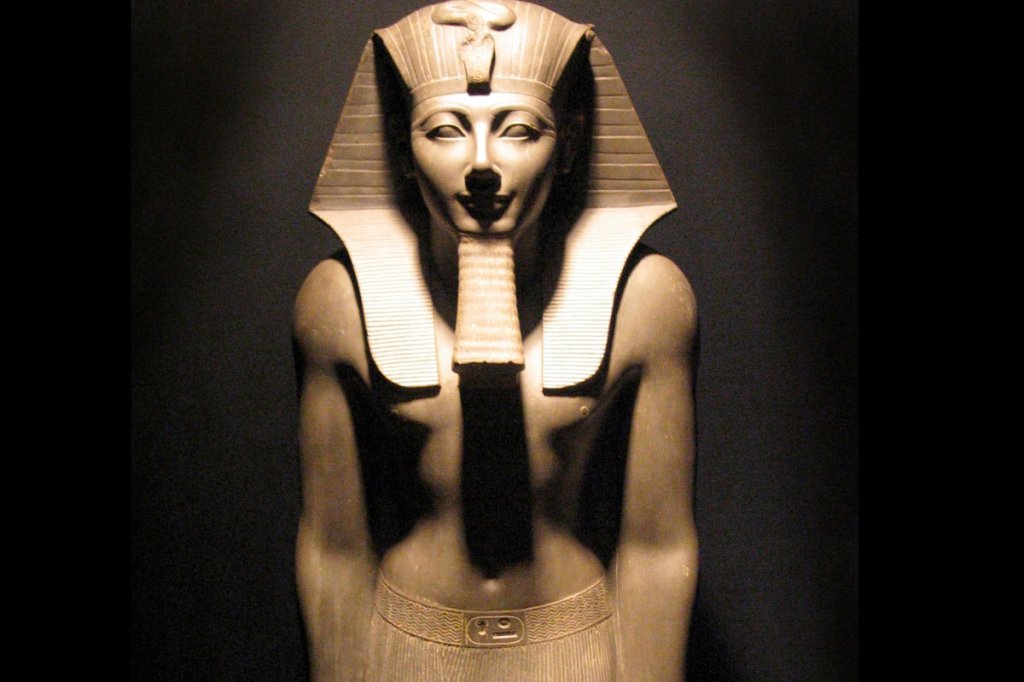

Credit:Wikipedia/Public Domain
FOLLOW OUR PODCAST ON (search opentheword):
PODCAST NOTES:
Over the years, Hollywood movies about Israel’s exodus out of Egypt have traditionally portrayed Pharaoh Ramses who reigned between 1303 BC and 1213 BC as the Exodus pharaoh.
However, there is universal agreement among Bible scholars that it definitely wasn’t Ramses because the Exodus took place several centuries before Ramses showed up.
Hi, my name is Dean Smith and in this podcast, I want to recant a previous podcast where I suggest that Amenhotep who came to power in 1525 BC was the pharaoh of the Exodus.
We know Amenhotep had a son who died as an infant and that fit well with the tenth plague, which saw the firstborn in Egypt killed,
But there is one verse.
Yes, a single verse completely disqualified Amenhotep, and I missed it. It’s really quite sad when you think of it because with Amenhotep’s firstborn son dying it fit the puzzle perfectly when it came to the last plague, the death of the firstborn.
But sadly, this single verse tells us that the Exodus did not take place until many years after Amenhotep had died.
The Pharaoh of the Exodus ruled sometime between Amenhotep and Ramses.
According to Exodus 7:7, Moses was 80 years old when he led Israel out of Egypt. Amenhotep was long gone when the Hebrews left Egypt.
We know that Moses spent about 40 years growing up in the pharaoh’s court after the pharaoh’s daughter found him lying in a basket floating on the Nile River.
Then he spent the next 40 years working as a shepherd in Midian, when he fled Egypt after killing an Egyptian guard who was beating a Hebrew slave. While in Midian, God called Moses to return to Egypt and take the Hebrews to the Promised Land.
So this leads to the tricky part, can we figure out what Pharaoh was in power when Moses was found floating on the Nile River. Because if we can determine that, we only need to add 80 years, and we should be able to calculate what Pharaoh was in power at the time Moses led Israel out of Egypt.
In Exodus 1:8-10, we are provided with three clues as to the identity of this pharaoh:
8 Now a new king arose over Egypt, who did not know Joseph. 9 And he said to his people, “Behold, the people of the sons of Israel are [a]too many and too mighty for us. 10 Come, let us deal shrewdly with them, otherwise they will multiply, and in the event of war, they will also join those who hate us, and fight against us and depart from the land. (Exodus 1:8-10 NASV)
First: We are told that there was a new King who rose over Egypt who did not know Joseph.
According to Keil & Delitzsch, a classic Old Testament commentary, the word new describes something completely different, not newer as in a buying a newer car to replace an older one. It’s different in a semi-trailer tractor versus a small car.
The word is used in Judges 5:8, to describe new gods. This is not describing new upgraded versions of old pagan gods, but rather a new completely different class of gods who were different from Jehovah
Secondly: We are told that this new king had no idea who Joseph or the Hebrews were. With Joseph and his extended family having been invited to live in Egypt by an earlier pharaoh, how is it possible that this new pharaoh suddenly had no idea who Joseph and the Hebrews were?
Thirdly: This new Pharaoh then decided to put the Hebrews into slavery because he was concerned that they would join with Egypt’s enemy if they decided to attack.
But the Hebrews had previously been invited to live in Egypt as friends by the previous pharaoh because of Joseph.
Why were they now considered potential enemies by the new pharaoh?
What happened? What changed?
These are all telling statements as they describe a chaotic period in Egypt’s history, around 1800 BC, when the Hyksos successfully invaded Egypt and drove the Egyptian government into the southern half of the Nile Delta.
As an occupying force, the Hyksos controlled the Northern half of the Delta. When they took over, they kept many of the same traditions and customs of the Egyptians and even used the term Pharaoh to describe their leaders.
The Hyksos ruled northern Egypt for about 200 years. They were Semitic, cousins of the Hebrews. This meant the Hebrews and Hyksos had a similar language and culture, and it explains why Joseph was able to eventually become second in charge in Egypt.
But that all changed in 1550 BC when under Pharaoh Ahmose, the Egyptians in the south were finally able to drive the Hyksos out of Northern Egypt and regain control of their country.
And that is why we are told that there was a ‘new’ king in Egypt. He was different from the Hyksos pharaohs who had previously sat on the throne.
It explains why Ahmose did not know who Joseph was and having just driven the Hyksos out of Northern Egypt why Pharaoh Ahmose was concerned that the Hebrews who were culturally similar to the Hyksos would join the Hyksos if they ever decided to re-invade Egypt.
This resulted in Pharaoh Ahmose putting the Hebrews into slavery.
It was during Ahmose’s reign, that Moses ended up being raised by one of the pharaoh’s daughters in the royal court.
Now if Moses was born during the reign of Ahmose, it should be fairly easy to determine who the Pharaoh was 80 years down the road.
It should be fairly easy, except for a couple of things.
Though we have a list of pharaohs who ruled Egypt after Ahmose, there are major disagreements on how long these dynasties lasted. When biographers list the years a particular pharaoh ruled, there is invariably a footnote that the years are in dispute.
Secondly, Moses was not born in 1550, the first year of Pharaoh Ahmose’s reign. When Ahmose revealed he was concerned about the Hebrews joining the Hyksos, he first tried to slow their growth by putting them into slavery.
When that failed, he then ordered the Hebrew midwives to kill the male babies. When they refused the Pharaoh then ordered the Egyptian army to kill the male babies by throwing them into the Nile. It was during this final stage that Moses was born.
This whole process would have undoubtedly taken several years.
And the Bible provides one more clue to the Pharaoh’s identity that ironically will be important. We know that the Pharaoh was a man, as God told Moses to confront the Pharaoh as ‘he was walking by the Nile’ in Exodus 7:15.
So let’s start the countdown to 80 years.
Pharaoh Ahmose: 25 years have passed
First, we have Pharaoh Ahmose who drove the Hyksos out of Northern Egypt and ruled between 1550 BC and 1525 BC. He was the new King that rose to power mentioned in Exodus 1:8. Moses was born during his reign. Ahmose ruled for a total of 25 years.
Pharaoh Amenhotep I: 46 years have passed
Ahmose was followed by his son Amenhotep I, the guy I originally thought was the Pharaoh of the Exodus. Amenhotep ruled 21 years between 1525 BC and 1504 BC, and it was possibly towards the end of his reign that Moses killed the Egyptian guard and fled to Midian. A total of 46 years have now passed.
Pharaoh Thutmose I: 59 years have passed
Amenhotep I is followed by Thutmose I. He was possibly the son, Amenhotep, but that is not certain. Thutmose I ruled 13 years, between 1506 BC and 1493 BC. A total of 59 years have passed.
Pharaoh Thutmose II: 72 years has passed
Thutmose I is followed by his son, Thutmose II. Like his father, he also ruled for 13 years between 1493 BC and 1478 BC. A total of 72 years have now passed.
Pharaohess Hatshepsut: 92 years have passed
However, when Thutmose II died at around 30 years of age, a strange thing happens. His wife, Hatshepsut, who was also his half-sister, takes the throne. This is one of the rare occasions a female held the role of the Egyptian pharaoh. She ruled roughly 20 years (very roughly) between 1478 BC and 1458 BC.
Some believe even during Thutmose II’s reign, Hatshepsut was the real power behind the Egyptian throne.
Though her reign brings us to a total of 92 years, we know that she was not the pharaoh of the Exodus, because we are told that the Exodus pharaoh was a man.
Thutmose III: Possible Contender for the Pharaoh of the Exodus
Hatshepsut was followed by Thutmose III and the dates for their two reigns are a bit blurred as for several years, she served as Thutmose III’s co-regent until he was old enough to rule.
In fact, at one point Hatshepsut declared herself to be Pharaoh, while at the same time calling Thutmose III the next pharaoh.
So based on the 80-year countdown from Pharaoh Ahmose, there are only two possible contenders for the Pharaoh of the Exodus, either Thutmose II who ruled before Hatshepsut or Thutmose III who came after. The problems with dating the times of the pharaoh’s reigns make both of them possible candidates.
Thutmose III is known as one of Egypt’s most powerful rulers and turned Egypt into an international superpower and gained the reputation of being a military genius among modern historians with some even calling him the Napoleon of Egypt.
And we know from the archaeological record that Thutmose III was a great builder, which included the construction of over 50 temples. And of course, construction is a major part of the Exodus story, because the Pharaoh ordered the Hebrews to find their own straw to construct his bricks.
But we can’t completely eliminate Thutmose II from this discussion on the best candidate for the Pharaoh of the Exodus.
Thutmose II was a minor Pharaoh that had few successes internationally, but recent archaeology suggests he was involved in several construction projects, which fits the Biblical narrative.
In his book, Old Testament History, Famed Bible scholar, Alfred Edersheim, makes the case for Thutmose II based on a couple reasons.
First, Thutmose had a prosperous, but brief reign that collapsed very suddenly, which coincides with the Hebrews plundering Egypt of their gold and silver when they left and the destruction of the Egyptian army at the Red Sea.
Secondly, his mummy, which is on display at the National Museum of Egyptian Civilization, is covered in scars showing evidence of major cysts that fits with the sixth plague of boils mentioned in Exodus 6.
So this is a recant, as I am now convinced that Thutmose was the Pharaoh of the Exodus. My only problem is I can’t decide if it was the second one or the third one.

 OpentheWord.org
Leave a comment